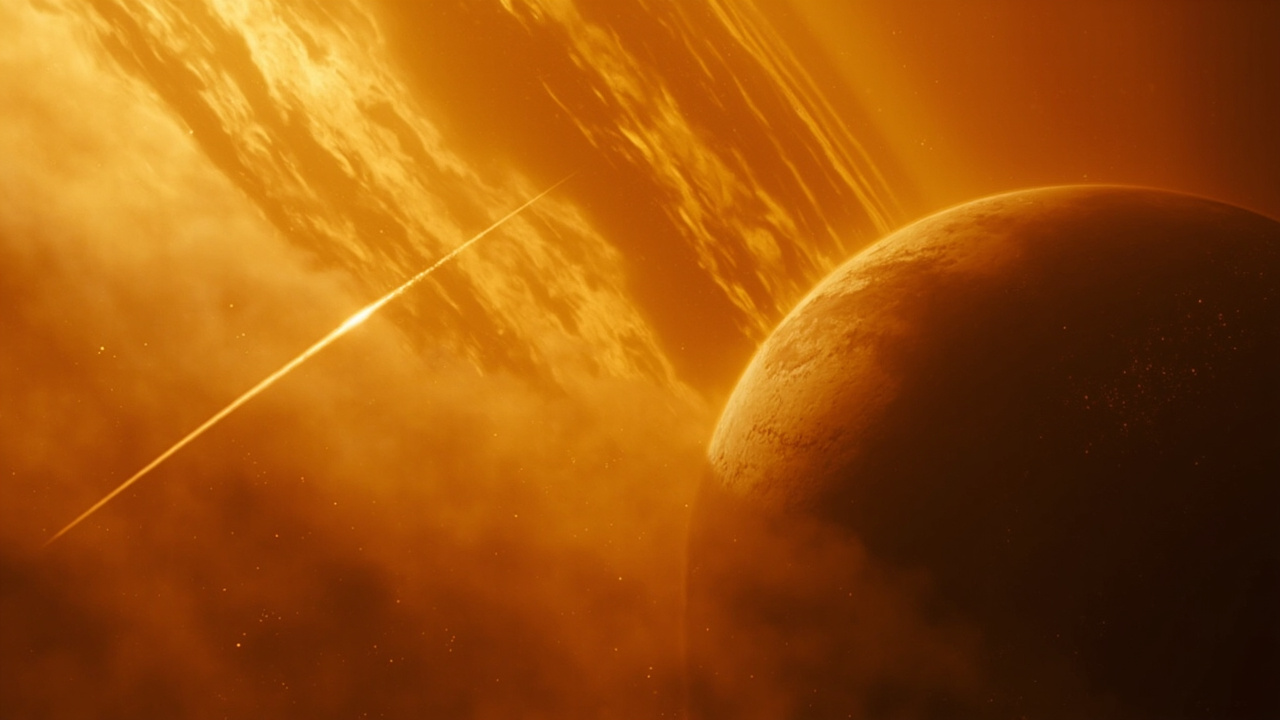
TL;DR: A Tohoku University model shows Venus' yellowish lower haze is sustained by meteor debris that seeds sulfuric-acid clouds, then remains as bare dust after the acid evaporates.
A five-decade haze gets an origin story
The yellowish veil near the base of the Venusian atmosphere was first recorded in the 1970s by Soviet Venera landers and NASA's Pioneer Venus probes, according to Ars Technica. Those missions were among the earliest to return successful images from the planet, yet the layer they detected stayed unexplained for decades.
Planetary scientist Hiroki Karyu and colleagues at Tohoku University in Sendai City, Japan, now link that feature to material arriving from space, the same outlet reports. Their tool was a microphysical model, a calculation of the microscopic steps that assemble clouds and precipitation on Earth and other worlds.
In the study in Nature Astronomy, Karyu stated that steady arrival of extraterrestrial dust can maintain the lower haze with the sizes measured by descent probes. He added that the resulting particles serve effectively as condensation seeds, encouraging growth of the overlying main cloud deck at locations distant from where the dust first arrived.
A separate summary from NeoTeo dates the underlying study to April 13, 2026, and describes the finding as a proposed match between modeled sizes and earlier entry-probe measurements rather than a direct sample of the haze.
Where the haze sits and what it contains
The lower haze is described as a population of small, nonvolatile particles — solids that resist evaporation — located between the surface and the principal cloud deck, according to NeoTeo. The particles seen by entry probes were smaller than one micrometer.
NeoTeo also reports that the modeled haze grains are enriched in magnesium and iron. That chemistry matters because meteoroids commonly deliver magnesium, silicon and iron to planetary atmospheres, and the Venus result ties the composition of incoming rocks to the composition of the lingering haze, according to Ars Technica.
The model indicates that continuous delivery is sufficient. Even without a single large event, the everyday rain of interplanetary particles can replenish the layer and preserve the size distribution recorded during past descents.
Volcanoes and surface dust do not fit
For years, researchers considered eruptions as a possible supplier. Venus holds a reputation as the most volcanically active planet in the solar system, with volcanic signatures first recognized by the Magellan spacecraft in the early 1990s and later work suggesting even greater activity, according to Ars Technica.
Karyu's group tested that idea and found volcanic ash an unsatisfactory match. Surface dust lifted from the ground also failed the test, the same report states.
The decisive issue was sulfur chemistry. Even greatly increased supplies of volcanic or ground material would not engage atmospheric sulfur in the manner needed to reproduce the observed haze, according to Ars Technica. A Ukrainian technology summary of the work, published by UA.NEWS, similarly states that modeling showed neither volcanic nor surface dust would interact with atmospheric components in a way that could build the observed particle layer.
That outcome shifted attention upward, toward infall from space, rather than material rising from below.
How meteors seed Venusian clouds
The proposed sequence begins much like a meteor shower viewed from the ground. Small space rocks captured by Venus encounter atmospheric gas, heat through collisions, and disintegrate, scattering fine solid residue, according to UA.NEWS and Ars Technica.
On Venus, sulfuric acid then uses those motes as surfaces for condensation. The mechanism parallels terrestrial cloud building, where water vapor needs a nucleus such as dust, soot, ash, salt or ice because isolated water molecules seldom join spontaneously in air. On Venus the condensable liquid is sulfuric acid rather than water, and the preferred nucleus is meteor residue.
Because these specks are hygroscopic in behavior, acid gathers on them and forms droplets. Those droplets accumulate into the broader cloud system, linking dust that burned up at high altitude to cloud growth elsewhere.
The authors describe the cosmic-origin grains as efficient condensation nuclei that assist formation of the main cloud deck, according to NeoTeo. In that picture, haze and clouds are not separate puzzles but two stages of one dust-driven cycle.
Why more dust does not mean more droplets
One counterintuitive result concerns number versus size. Additional meteor particles do not simply create proportionally more cloud droplets, according to Ars Technica.
Instead, several mineral grains first adhere to one another, producing larger composite clusters before substantial acid condensation begins. Acid then coats those aggregates, and the combined particles gain mass.
Once heavy enough, they descend toward hotter depths. In the scorching lower atmosphere, where temperatures can reach 100 degrees Celsius, or 212 degrees Fahrenheit, the sulfuric-acid component evaporates, the same outlet reports.
What remains are the stripped mineral cores. Those denuded particles constitute the haze itself, a residue left after a cloud particle lost its volatile coating during its fall.
An iron clue to the ultraviolet mystery
The same work may clarify a second long-running question: the identity of a substance that absorbs ultraviolet light and helps create Venus' ultraviolet-dark markings, according to NeoTeo.
Meteor debris contains magnesium, silicon and iron. Magnesium- and silicon-bearing materials proved poor absorbers of ultraviolet radiation, while iron-bearing compounds looked more plausible, according to Ars Technica.
Earlier missions had already glimpsed iron without explaining it. Venera and Vega spacecraft sensed atmospheric iron, and the mass spectrometer aboard the Pioneer Venus Large Probe registered iron sulfate, yet those detections remained disconnected for decades.
The new calculation finds that iron sulfate properties align with the haze characteristics, supporting lingering suspicion that iron compounds provide the missing absorption. NeoTeo characterizes iron more cautiously as a plausible source of the unidentified ultraviolet absorber, preserving the distinction between a strong model match and a completed identification.
A barrier that sorts particles by altitude
Altitude changes the physics. At roughly 40 to 50 kilometers above the surface, about 25 to 31 miles, sulfuric-acid droplets cannot readily attach to some haze grains, according to Ars Technica.
The obstacle is a nucleation barrier: the energetic state of the particle prevents acid from establishing a stable coating. UA.NEWS describes the same interval and barrier, noting that droplets cannot attach there.
Grains strongly affected by that barrier do not stay put. Rising warm air carries them upward through convection into the cooler upper cloud layer, where temperatures permit incorporation into sulfuric-acid particles, both summaries report.
Earlier observations had hinted at such transport, but Karyu's team presents stronger modeling evidence for it, according to Ars Technica. The result helps explain how high clouds acquire mineral inclusions even though the ultimate dust source burns up elsewhere.
What Venus may teach about giant planets
The authors frame Venus as a test case for thick atmospheres generally, with possible lessons for gas giants and exoplanets, according to NeoTeo.
Upper hazes on giant planets have received extensive study, but processes operating beneath the main cloud decks remain poorly understood, according to Ars Technica. Venus offers a worked example in which non-evaporating infall influences layers below and within the clouds.
For a planet such as Jupiter, comparable refractory debris from meteoroids might settle onto the outer portions of clouds rather than vanishing, the same outlet reports. Similar investigations could illuminate how extraterrestrial dust encourages cloud and haze development on Saturn and Neptune as well.
UA.NEWS likewise states that the authors view cosmic dust as an important climate component and suggest that comparable processes may assist studies of cloud and haze formation on Jupiter, Saturn, Neptune and exoplanets. The emphasis remains on future inquiry, not a claim that those worlds have already been shown to work exactly like Venus.
Sources referenced
- Venus' mysterious haze is actually cosmic dust - Ars Technica (https://arstechnica.com/science/2026/10/venus-mysterious-haze-is-actually-cosmic-dust/)
- Venus haze: how cosmic dust may sustain the lower layer | NeoTeo (https://www.neoteo.com/en/a-model-links-venuss-lower-haze-to-cosmic-dust)