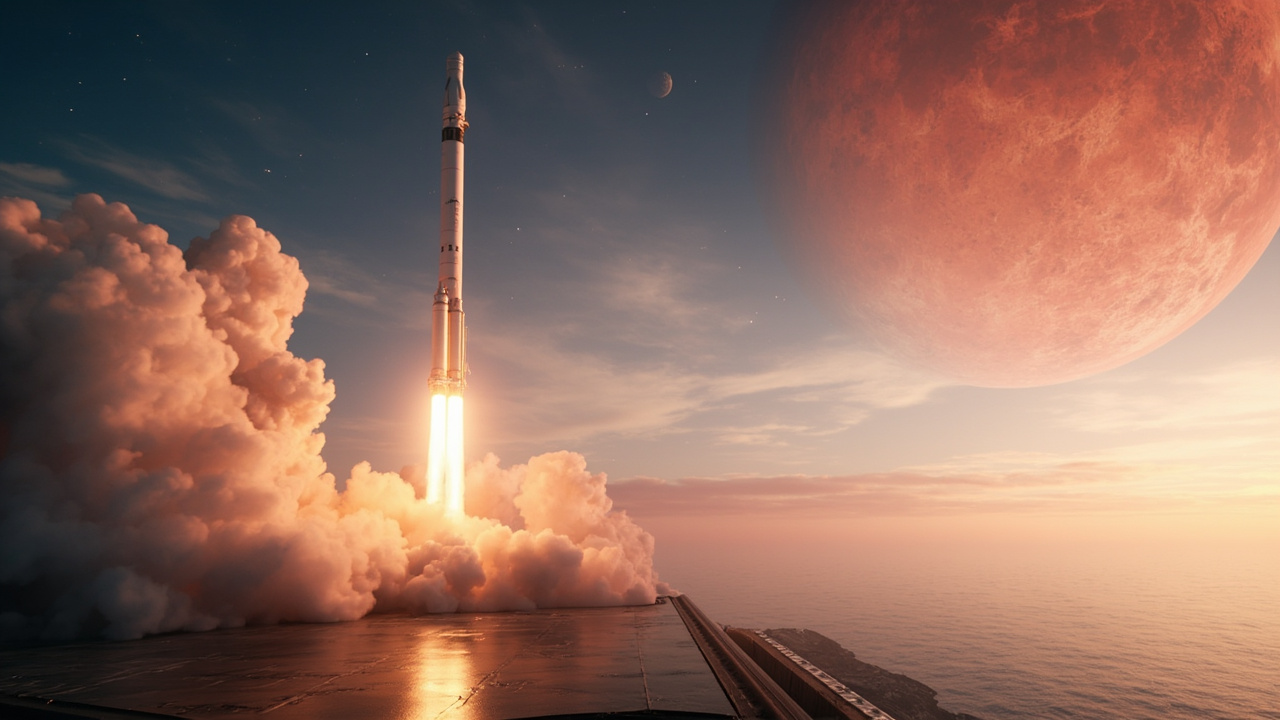
TL;DR: Japan launched its Martian Moons eXploration spacecraft on Oct. 19, 2026, starting a mission to land on Phobos, collect at least 10 grams of soil, and return it to Earth in 2031.
Japan gets off the ground after a long wait
The Martian Moons eXploration mission, known as MMX, lifted off on Oct. 19, 2026, at 3:41 p.m. EDT, which was 1941 GMT and 4:41 a.m. on Oct. 20 at the launch site in Japan, according to Space.com.
The spacecraft left Tanegashima Space Center in Japan from Pad-2 of the Yoshinobu Launch Complex. It rode an H3 rocket, Japan's expendable two-stage launcher jointly developed by the Japan Aerospace Exploration Agency and Mitsubishi Heavy Industries.
The flight was the 10th liftoff for the H3, which stands about 207 feet tall, or 63 meters. After clearing the pad, the vehicle headed over the Pacific Ocean on a nominal ascent path.
The H3 dropped its four solid boosters in pairs shortly before two minutes into flight. About one minute and 20 seconds later, it shed its payload fairings, exposing MMX to space for the first time.
The first stage uses two LE-9 engines burning liquid hydrogen and liquid oxygen to generate a combined 331,000 pounds of thrust, equivalent to 1,471 kilonewtons, according to Mitsubishi Heavy Industries as reported by Space.com. Main engine cutoff came near T+5 minutes, followed by stage separation and ignition of the second stage about 10 seconds later for a burn lasting about 5.5 minutes.
A second burn of the upper stage, intended to send MMX toward Mars, was planned for about one hour and four minutes after liftoff and was expected to last about six minutes and 25 seconds. Spacecraft separation was set for about one minute after that maneuver, while flying about 368 miles, or 592 kilometers, above central Africa.
The mission had originally been aimed for launch in 2024. Problems with the H3 rocket prevented that departure, and because Earth and Mars align for interplanetary launches only about once every 26 months, MMX had to wait for the next opportunity, according to Space.com.
Coverage was carried by the Japan Aerospace Exploration Agency, with live streaming beginning at 2:45 p.m. EDT. JAXA invited viewers to follow updates through its English-language account and the MMX hashtag.
A decade-long round trip to Mars
Once released, MMX began a roughly 10-month cruise to Mars under its own power. Arrival at the Red Planet is scheduled for August 2027, with insertion into orbit near Phobos expected in September 2027, according to the European Space Agency.
ESA describes MMX as led by JAXA in collaboration with NASA, France's CNES, the German Aerospace Center DLR, and ESA itself. The agency said MMX will be the first mission to collect a sample from Phobos and return it to Earth, and the first mission to come back to Earth after visiting the Mars system.
After Mars arrival, the propulsion module is expected to place MMX into a quasi-satellite orbit associated with Phobos. In that arrangement, the spacecraft remains in the vicinity of the moon while both objects circle Mars.
MMX is expected to spend about three years in the Martian system. Much of that period will be devoted to remote study of Phobos, which measures about 14 miles, or 22 kilometers, across. The spacecraft will also observe Deimos, the smaller Martian moon, with a diameter of about 8 miles, or roughly 13 to 14 kilometers.
According to ESA, the spacecraft will study both moons from a distance for about 18 months before proceeding to surface operations. The broader schedule calls for departure from the Mars region in November 2030. If the plan holds, the sample-return capsule will land in Australia in 2031.
ESA said the capsule will then be transferred to Japan, where the material will be removed, catalogued and shared with mission partners. Samples are planned to be made available to European researchers, with ESA working alongside CNES, DLR and JAXA on opportunities to study them. Agency officials noted that even tiny amounts of returned material can support detailed laboratory measurement.
Why Phobos matters to scientists
Mars has two moons, Phobos and Deimos, whose names evoke fear and terror. Despite many spacecraft sent to Mars itself, the moons remain poorly understood because no mission has operated close to them for an extended period, according to ESA.
Their origin is the central puzzle. One hypothesis holds that they are asteroids from the early solar system captured by Martian gravity billions of years ago. The other holds that they formed from debris thrown into orbit by a giant collision involving Mars, somewhat paralleling current thinking about Earth's Moon.
Evidence cited for an impact origin includes their near-circular orbits near the Martian equator. Evidence cited for a capture origin includes their irregular, oblong shapes and compositional clues obtained through telescopic spectroscopy, according to Space.com. Both moons are lumpy rather than spherical, often compared to potatoes.
Tom Statler, MMX program executive and program scientist at NASA Headquarters, said in an Oct. 15 statement reported by Space.com that the moons may be remnants of a massive impact that sent material into Mars orbit, or ancient asteroids captured by Martian gravity. Statler added that resolving the question would help illuminate an early era when Earth and other inner planets may have been acquiring water and organic compounds.
NASA is participating in MMX by supplying a scientific instrument, a technology demonstration, communications support and funding for U.S. researchers on the team.
ESA MMX Project Scientist Elliot Sefton-Nash said the data and samples from MMX offer a window for studying the evolution of Mars and the solar system. He said Mars has changed substantially since forming 4.5 billion years ago and may once have hosted conditions suitable for life.
Sefton-Nash also said bringing samples to terrestrial laboratories multiplies discovery because the most precise instruments are too large, complex or sensitive to fly in space. He added that future generations could re-examine Phobos material with still more advanced tools, making returned samples valuable long after the flight ends.
Mission planners say identifying whether Phobos material resembles Martian rock or asteroid matter will provide clues to the geological past of Mars, the early history of the solar system and the formation of inner planets.
Rover, landings and a Deimos farewell
MMX carries 11 science instruments in total: seven on the main spacecraft and four on the rover, according to ESA. The main spacecraft also carries a radiation monitor, two high-resolution cameras and two different sampling devices.
A major payload is the 25-kilogram rover called Idefix, developed jointly by France and Germany. The 55-pound vehicle is scheduled to be deployed to the surface of Phobos in late 2028 or early 2029, with ESA citing early 2029 in its prelaunch timeline.
The rover has two principal jobs: gathering information needed to prepare for the main spacecraft's landing and sample collection, and analyzing the composition and texture of the surface. ESA officials noted the extremely weak gravity at Phobos, saying the rover would weigh only the equivalent of 15 grams, or about 0.5 ounces, there. Special techniques were developed to land, move and sample robotically under those conditions.
According to Space.com, MMX will first conduct a mapping campaign to choose suitable landing locations. It will then perform two separate touchdowns on Phobos to collect and store material in its return capsule.
The first spacecraft to orbit Phobos in a quasi-satellite orbit, MMX also aims to become the first to collect samples from the surface of a moon other than Earth's Moon.
After the second sampling operation, the spacecraft is expected to return briefly to the vicinity of Phobos. It will then shift into a more elongated orbit around Mars that crosses the path of Deimos.
During the final months around Mars, MMX is expected to make a series of Deimos flybys while continuing observations of Mars itself. ESA's long-running Mars Express orbiter, confirmed to operate at Mars until at least 2029, may be able to support MMX observations. ESA also said its upcoming ExoMars Rosalind Franklin rover will complement MMX by sampling beneath the Martian surface and analyzing material with onboard laboratory equipment.
Japan already has a record in sample return. Its Hayabusa mission brought home material from asteroid Itokawa in 2010, and Hayabusa2 returned material from asteroid Ryugu a decade later, according to Space.com. MMX would extend that experience from asteroids to the Mars system and attempt the first round trip from that region to Earth.
If touchdown, collection and departure proceed as designed, researchers expect laboratory study of composition and mineralogy to compare chemical fingerprints from Phobos with Martian rocks and asteroid material. Those results, combined with orbital measurements, are intended to settle the long-running debate over how Mars acquired its moons.
Sources referenced
- Japan launches historic MMX sample-return mission to Mars' moon Phobos (video) | Space (https://www.space.com/space-exploration/launches-spacecraft/japan-launches-historic-mmx-sample-return-mission-to-mars-moon-phobos)
- Mars moon lander set to launch on 19 October | ESA (https://www.esa.int/Science_Exploration/Space_Science/Mars_moon_lander_set_to_launch_on_19_October)