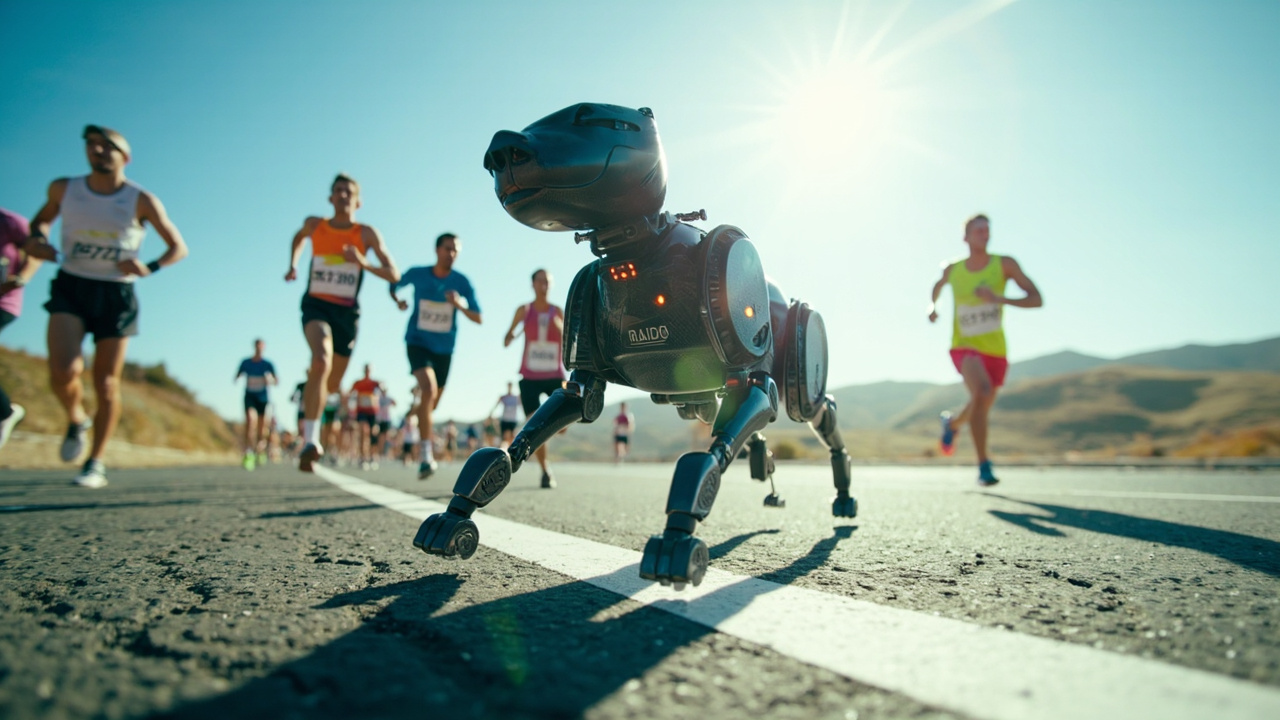
TL;DR: A four-legged robot named RAIBO2 finished a full 42.195-kilometer marathon in 4 hours, 19 minutes and 52 seconds on one battery charge.
South Korea's KAIST team reported the result in the journal Nature on Sept. 23, 2026, after analyzing data from a public road race the robot ran in November 2024.
A marathon run on public roads
RAIBO2 joined human runners at the start of the 22nd Sangju Dried Persimmon Marathon in Sangju, North Gyeongsang province, according to The Dong-A Ilbo. The newspaper places the race on Nov. 17, 2024, while a companion report from DongA Science describes the same event as held in November 2024.
The robot climbed and descended the course and crossed the finish line after 4 hours, 19 minutes and 52 seconds. It covered all 42.195 kilometers, or 26.2 miles, without battery charging or replacement, according to DongA Science.
That made it the first quadruped robot to complete a full course in a standard marathon event, according to DongA Science. The outlet also described RAIBO2 as the only walking robot to date to have finished an official full marathon without changing its battery.
KAIST announced that the long-distance locomotion work and marathon record were published as a paper in Nature on Sept. 23 local time, according to DongA Science. The paper is titled "A quadruped robot designed to complete a marathon on a single battery charge," by Choongin Lee and colleagues.
DongA Science reported that the publication was the first time quadruped robot research had appeared in the main issue of Nature, and the first time robot research conducted in Korea had been featured there. The team was led by Professor Hwangbo Jaemin of KAIST's mechanical engineering department, also rendered as Jemin Hwangbo in English-language coverage, according to Scientific American and DongA Science.
Why distance was a systems problem
The research team treated long-distance walking as a problem of the complete machine rather than the performance of a single part such as the battery or motor, according to DongA Science.
That framing mattered because quadruped robots must use joint motors to support their bodies continuously, even while standing, according to DongA Science. When legs swing back and forth, friction occurs in joints and gear reducers, and each foot contact brings impact and slipping losses. Heat is also generated in motors and electrical circuits.
Researchers found that about two-thirds of a robot's energy budget is lost as heat in the motors and their drive electronics, according to Scientific American. The remainder goes into friction in the gears, feet that slip, and the jolt of each footfall.
"What matters is energy consumed per unit of distance," study lead author Choongin Lee, a roboticist at the Korea Advanced Institute of Science and Technology, told Scientific American.
The team mapped where RAIBO2 lost energy while running and used the results to shape its design, according to The Dong-A Ilbo. Some electricity driving leg-joint motors was lost as heat, while friction between moving joints and gears also drained energy, as did impact and slippage of the feet against the ground.
Light legs, efficient electronics and a bigger battery
To reduce those losses, the team made the legs lightweight to cut losses from movement and impact, according to DongA Science. It selected motors and drive circuits to minimize power loss and developed motor drivers in-house to optimize energy flow from the battery to the tips of the feet.
The researchers cut the weight of each leg, designed low-resistance motor boards and spent the freed-up mass budget on a bigger battery, according to Scientific American. They combined that approach with motors that produced the same torque for less current.
The point was not simply to add capacity. "RAIBO2 is not a robot that simply runs farther by mounting a larger battery; it is the result of redesigning the entire robot so that as much of the energy stored in the battery as possible is converted into actual travel distance," Hwangbo said, according to DongA Science.
The team also addressed operating speed. A slower pace would require onboard computers and sensors to run longer, raising total power use, while a faster pace would demand more energy for leg motion and landings, according to The Dong-A Ilbo. The researchers calculated the most efficient pace at about 3 meters per second, where RAIBO2 could travel farthest.
During the marathon the robot averaged about 9.7 kilometers per hour, according to DongA Science. Uphill sections drew more power, while on descents the team used the motors as generators to recover energy and feed it back into the battery, according to The Dong-A Ilbo. Scientific American similarly reported that RAIBO2 was designed to recuperate and recharge the battery on downhill stretches.
A gait learned in simulation
RAIBO2's walking behavior was developed through artificial intelligence and physics simulation rather than only by hand tuning.
Lion Robotics, a KAIST faculty startup founded in 2023 and headed by Hwangbo, trained the control system using RAISIM, a high-speed, high-precision robot physics simulation platform, according to DongA Science. In the virtual environment, RAIBO2 could repeatedly experience gait patterns and terrain conditions without moving the physical hardware.
The walking style was trained with reinforcement learning, in which the control algorithm was rewarded for setting the feet down softly and for avoiding slip and overheating, according to Scientific American. The gait-control policies minimized landing shocks, slipping, unnecessary joint motion and power consumption, according to DongA Science.
"We have demonstrated with real marathon data how a robot should be designed to simultaneously achieve high locomotion performance and energy efficiency," Hwangbo said, according to DongA Science.
During the race, researchers continuously recorded internal voltage and current, power consumption of each joint, temperature and battery status, according to DongA Science. Position, speed and altitude data measured by GPS were synchronized with internal data, creating a scientific basis for analyzing long-distance locomotion.
How far it can go on one charge
The efficiency gains translated into range well beyond the marathon distance.
RAIBO2 travels roughly three times farther per charge than other quadrupedal robots, with a projected range of around 40 miles, according to Scientific American. Applying real-world driving data to the mountable battery capacity suggests the robot can travel up to approximately 65 kilometers on a single charge, according to DongA Science.
The Dong-A Ilbo reported that the robot consumed about 1,280 watt-hours over the full marathon. DongA Science reported that improved efficiency left RAIBO2 with remaining battery capacity after running the marathon.
The outlet also reported that RAIBO2 needs less energy to carry a kilogram over one meter than the average human runner. Scientific American phrased the same finding as the robot needing less energy to carry a kilogram over a distance of one meter than the average human runner.
For context on speed, Scientific American reported the marathon time as slightly ahead of the human average. The run followed other recent robot running demonstrations, including humanoid robots racing in China that required several battery swaps from a support team jogging alongside, a setup University of California, Santa Barbara engineer Katie Byl likened to a "mobile pit crew," according to Scientific American.
Still steered by a human
The marathon did not demonstrate full autonomy.
"RAIBO2 is basically running blind," Byl told Scientific American. The robot carried a camera but had no software to interpret the road, so a human operator steered it remotely.
Adding more autonomy will cost power, Lee told Scientific American. To limit the efficiency penalty from an added electronic brain, his team is working on smaller onboard networks and sensors. "This way the robot can become more capable without a large increase in power consumption," Lee said, according to Scientific American.
Outside assessment was positive on the combination of capabilities. "I'm impressed with their ability to combine efficiency with speed and mobility in a quadruped," Carnegie Mellon University mechanical engineer Sarah Bergbreiter told Scientific American. Bergbreiter was not involved in the study, nor was Byl, according to Scientific American.
What comes next for industrial use
Based on in-house capabilities spanning mechanical structure, electronics, motor drivers, software and AI, Lion Robotics plans to extend RAIBO2's long-distance locomotion technology to industrial quadruped robots, according to DongA Science.
Commercial use would require repeating the same performance across multiple units while keeping production costs low, according to DongA Science. Industrial environments also demand waterproofing and dust protection, a wide operating temperature range, durability against shock and vibration, and electromagnetic interference and compatibility handling.
"Lion Robotics' next goal is to implement our world-class energy efficiency and locomotion performance in products that anyone can use reliably in actual industrial settings," Hwangbo said, according to DongA Science.
Sources referenced
- Scientific American - Watch a robot dog run a marathon faster than the average human (https://www.scientificamerican.com/article/watch-a-robot-dog-run-a-marathon-faster-than-the-average-human/)
- DongA Science - KAIST's RAIBO2 quadruped robot completes 42.195 km marathon on a single battery (https://www.dongascience.com/en/news/80059)