TL;DR: Australian engineers turned giant burrowing cockroaches into steerable “paraborgs” that located test targets every time and delivered simulated drugs successfully in 72% of lab trials.
Paramedic insects aim to reach people rescuers cannot
Scientists from the University of Queensland and the University of New South Wales have built cyborg cockroaches intended to carry emergency treatment into collapsed buildings, caves and other confined areas, according to Reuters reporting republished by CNA.
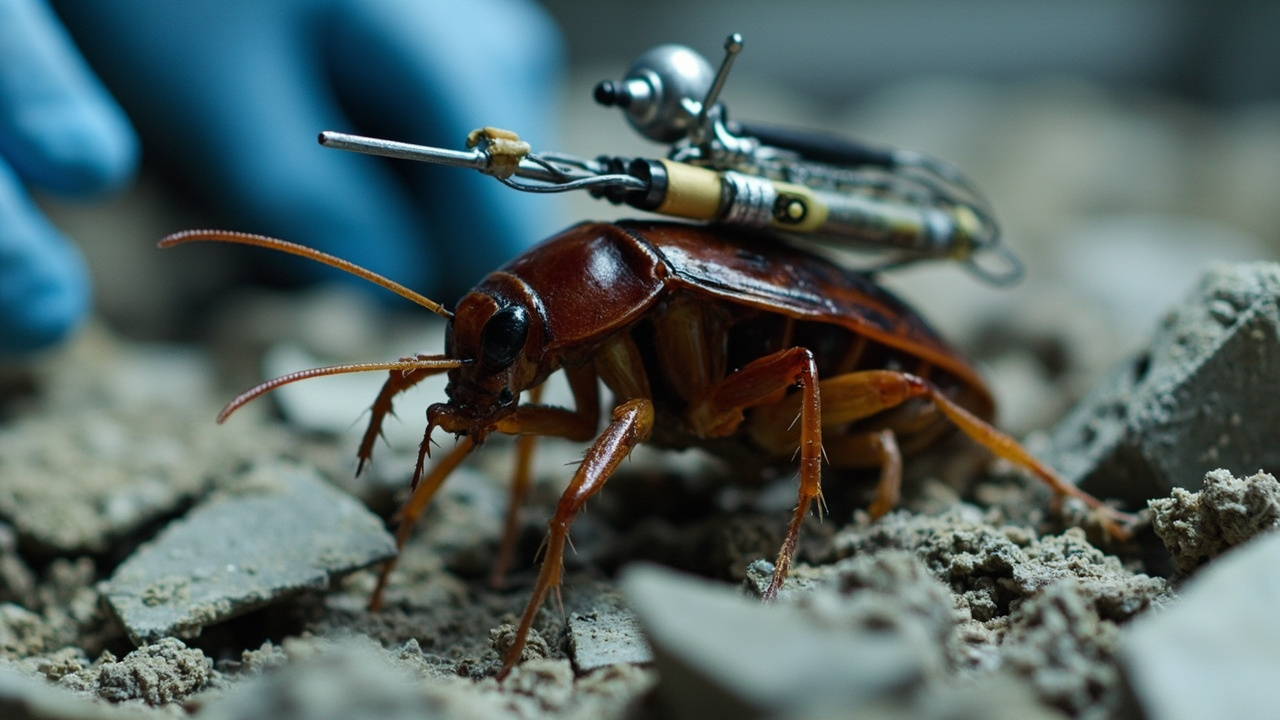
The team calls the insects “paraborgs.” Each animal wears a miniature pack that holds either a camera for visual feedback or a remotely triggered injector loaded in a small syringe cylinder, the same reporting says.
The goal is basic medical assistance before human teams arrive. Researchers said the insects could help keep victims of earthquakes and building collapses alive while trapped in narrow, debris-filled spaces.
The work appeared in the journal Advanced Science. A University of Queensland announcement distributed by EurekAlert! on Aug. 26, 2026 described the project as proof-of-concept testing at UQ’s School of Mechanical and Mining Engineering.
A Reuters photograph dated July 27, 2026, in Brisbane shows a researcher holding one of the equipped insects fitted with what the caption calls a human-supervised auto-injection mechanism, or AIM.
Why researchers selected this cockroach
The project uses North Queensland giant burrowing cockroaches, identified scientifically as Macropanesthia rhinoceros, according to the EurekAlert! announcement.
The species is described as the heaviest cockroach species in the world, measuring up to 8.5 centimetres, or 3.3 inches, according to CNA’s republication of the Reuters report.
Size mattered because payload mattered. The EurekAlert! announcement says the larger cockroaches provide greater capacity to carry specialized rescue and medical equipment than the group’s earlier insect models.
The same announcement says the UQ Biorobotics Lab previously demonstrated cyborg beetles capable of controlled climbing. The team’s approach, in the words attributed to biorobotics engineer Thang Vo-Doan, is to harness the natural strengths of different insects and equip them for different missions rather than building one robot to do everything.
Living insects were chosen because no manufactured robot could match their agility, resilience and low power requirements, researchers said, as reported by CNA.
How operators steer the insects
Control relies on implanted electrodes. Operators apply a small electrical signal to stimulate the nervous system and direct movement, according to the CNA republication.
Study co-author Thang Vo-Doan, a biorobotics engineer, described anaesthetising and immobilising the insect before implantation so that it cannot feel anything during the implementation process, the same report says.
Once an electrode is implanted, the operator can activate or stimulate the nerve system so the insect responds to commands, Vo-Doan said in the report.
The EurekAlert! announcement adds that the animals are anaesthetised during electrode and microchip fitting and live for as long as other cockroaches once the harnesses are removed.
Accurate positioning was one of the central engineering problems. PhD candidate Hai Nhan Le said the cyborg insect has to navigate to the target, position itself accurately and remain stable enough to perform the injection, according to the EurekAlert! announcement.
Observer and injector worked as a pair
Tests divided responsibilities between two insects. One “observer” cockroach carried a camera to locate targets for operators, while a second cockroach carried drugs to be remotely triggered, according to CNA.
The lightweight electronics included cameras for visual feedback and remotely activated auto-injection systems custom-made for the species, according to the EurekAlert! announcement.
That division supports the researchers’ longer-term idea of specialized swarms. Vo-Doan said some insects could carry cameras and environmental sensors while others carry specialized emergency or medical equipment, the EurekAlert! announcement says.
The intended result is complementary roles inside rubble. Vo-Doan said a future network of many insects could go deep into a collapsed structure and find a victim as soon as possible, according to CNA.
What laboratory testing measured
The study recorded a 100% success rate in reaching designated checkpoints during tests, according to CNA.
The complete navigation-and-injection task succeeded in 72% of trials, according to the EurekAlert! announcement. CNA describes the same figure as an overall drug-delivery success rate of 72%.
Distance strongly affected injection performance. When injection was launched from within 15 centimetres, or 5.9 inches, of a target, success rose to as high as 95%, according to CNA. The EurekAlert! announcement similarly reports 95% success with close-range injection positioned within 15 centimetres of the target.
The experiments were performed using silicone targets and pig skin under controlled laboratory conditions, according to CNA.
From locating victims to treating them
Earlier work on cyborg insects focused on using them to locate victims rather than to treat them, the study said, according to CNA.
The new project attempts to move beyond searching. UQ biorobotics engineer Thang Vo-Doan said cyborg insects have been designed for “search and explore” missions for the past couple of decades, according to the EurekAlert! announcement. He then posed the research question: once they find someone, can they actually help?
Vo-Doan described the change as transforming the cyborg insect from a mobile sensor into a tiny rescue platform, while critical medical decisions remain under human control, the same announcement says.
Associate Professor Thanh Nho Do, director of the UNSW Medical Robotics Lab, framed the biomedical opportunity as bringing treatment to a patient when the patient cannot yet be brought to treatment, according to the EurekAlert! announcement. He described the long-term goal as targeted, human-supervised intervention in places conventional medical technologies cannot access.
Emergencies where minutes could matter
The study said such a system could eventually be used to stabilise victims in situations where minutes mattered, including snake bite emergencies and severe allergic reactions, according to CNA.
The researchers also discussed earthquake and building-collapse response. They hope the insects could provide basic medical assistance in narrow, debris-filled spaces before rescuers arrive, the same report says.
PhD candidate Hai Nhan Le, a co-author of the Advanced Science study, acknowledged that many people might dislike a giant cockroach approaching them but said such an insect could make a real difference between life and death for someone trapped in rubble or stuck in a cave, according to CNA.
Fire and Rescue NSW also commented on possible operational use. Superintendent Tim Hassiotis, manager for natural disaster and humanitarian work, said that if cyborg insects can safely enter spaces rescuers cannot, locate casualties and ultimately help deliver emergency care, they could become another valuable tool in the future of urban search and rescue, according to the EurekAlert! announcement.
Limits found in the laboratory
The study said further testing would be needed to address challenges operators would face in real-world applications, including complex terrain, signal loss in collapsed structures and injection safety, according to CNA.
Those issues reflect the gap between controlled tests and disaster sites. The laboratory work used silicone targets and pig skin, not people, unstable rubble or interrupted radio links.
The ethical picture remains unsettled. Ethical guidelines for research on insects are not yet standardised, the study said, according to CNA. The same report says the cockroaches were kept in a suitable living environment and fed dry gum leaves and apples.
What could come next
The researchers envision swarms with specialised roles rather than a single multipurpose insect, according to the EurekAlert! announcement.
Vo-Doan said the vision is not to replace first responders, but to give them another way to see, reach and potentially help people when direct access is impossible, the same announcement says.
Vo-Doan also estimated that cyborg insect rescue teams could help people in real emergencies within the next five to 10 years, provided the researchers have resources to accelerate research and field testing, according to the EurekAlert! announcement.
For now, the demonstrated advance is narrow but concrete: a camera-equipped insect can guide operators, a second insect can approach a designated point, and a remotely supervised injector can deliver its payload most reliably at very short range.
Sources referenced
- Roaches to the rescue: Australian scientists develop cyborg cockroaches for medical missions - CNA (https://www.channelnewsasia.com/business/roaches-rescue-australian-scientists-develop-cyborg-cockroaches-medical-missions-6344976)
- Paramedic cockroaches: Cyborg care when rescuers can’t reach | EurekAlert! (https://www.eurekalert.org/news-releases/1141518)