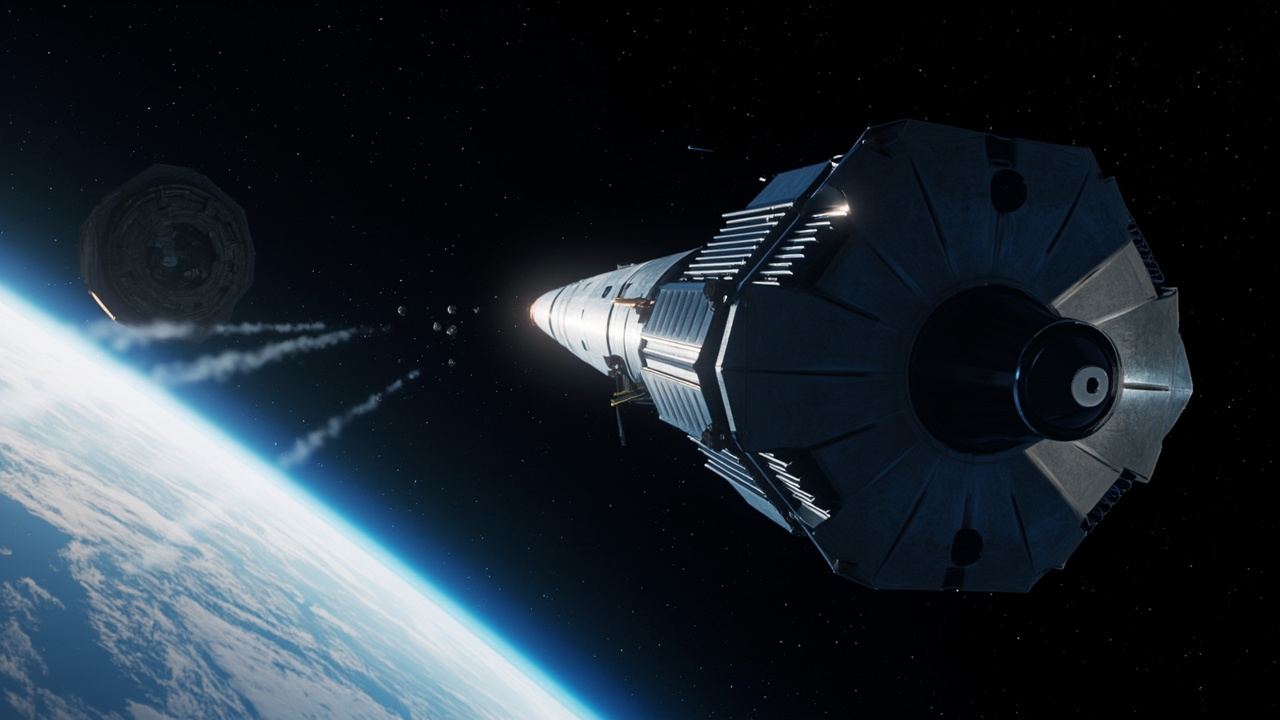
TL;DR: SpaceX flew Starship to Earth orbit for the first time on September 28, 2026, and released 26 Starlink V3 satellites before bringing the vehicle home early to the Pacific Ocean.
Starship finally reaches orbit and drops off 26 Starlinks
SpaceX put Starship into Earth orbit for the first time on Monday, September 28, 2026, then used the vehicle to release its first operational orbital payload: 26 Starlink V3 internet satellites.
According to SpaceX, liftoff occurred at 7:48 a.m. CT from Starbase, Texas, on the program's 14th flight and its first attempt to go to orbit. The company described the mission as both the first orbital Starship flight and the first to deliver meaningful payload to orbit.
The test was uncrewed and deliberately shortened after propulsion trouble. According to Reuters, the mission had been scheduled to last 10 hours but was reduced to about three hours after an engine shutdown. According to NPR, managers cut a planned 10-hour, six-orbit profile to about three hours, while live coverage summarized by the BBC said the vehicle circled Earth about two times rather than completing the longer planned flight.
Liftoff from Starbase on Flight 14
The vehicle that flew was a two-stage system comprising the Super Heavy booster and the Ship upper stage. According to NASASpaceFlight.com, the combination was Booster 21 with Ship 41, launching from Pad 2 at Starbase at 7:48:59 a.m. CDT.
According to SpaceX, the Super Heavy booster ignited all 33 of its Raptor 3 engines and climbed over the Gulf of America. One booster Raptor shut down during the initial climb. The booster then completed first-stage ascent and separated through a hot-staging maneuver, during which the Ship's six Raptor engines ignited.
Space documentation compiled by Space.com before launch had anticipated a 75-minute window opening that morning and a mission lasting up to 10 hours with as many as six orbits. That preflight expectation matches the roughly 10-hour duration later referenced by Reuters, NPR and the BBC as the original plan.
No people were aboard. According to NPR, the 171-foot-tall vehicle flew without crew, while the booster was intended to simulate an offshore landing rather than return for a tower catch.
Booster tests limits over the Gulf
After separation, the booster turned for its return leg. According to SpaceX, Super Heavy performed a directional flip and relit 31 of the planned 33 Raptor engines for its boostback burn.
That burn was intentionally designed to consume remaining liquid oxygen in the booster's main tank, according to SpaceX, in order to test performance limits ahead of future return-to-launch-site missions. The company said the booster later reignited 11 of the planned 13 engines for the high-thrust part of the landing burn, then reduced thrust from five engines for trajectory adjustment to three engines before water contact.
The booster splashed down in the Gulf. According to NASASpaceFlight.com, Booster 21 completed its boostback for the full duration despite operating with 31 engines, then started its landing burn with 11 engines and reached its target splashdown point. According to SpaceX, the flight termination system was triggered after landing-burn shutdown as a demonstration of safety hardware.
The outcome was treated as useful engineering data despite missing several engine ignitions. According to NASASpaceFlight.com, the booster flight was considered a complete success in its major objectives even with engine losses in different phases. The site also reported that Booster 22 was expected to become the first Block 3 booster to attempt a catch on Flight 15.
According to NPR, SpaceX used this flight to test upgrades to booster software and hardware. The booster approach contrasts with the company's longer-term goal of catching returning boosters with the launch tower, a method previously demonstrated in October 2024 and noted by the BBC in its live coverage.
Engine shutdown forces an orbit decision
The Ship's climb did not go exactly as planned. According to SpaceX, all six upper-stage Raptors initially ignited at hot-staging, but one Raptor vacuum engine shut down early during ascent.
The remaining five engines burned longer than planned to compensate, according to SpaceX, allowing the vehicle to reach its planned passively safe suborbital trajectory. That trajectory was significant because it meant the vehicle would return naturally even without further action, a precaution SpaceX had used throughout earlier suborbital testing.
Controllers then evaluated whether to continue. According to SpaceX, the flight control team assessed Ship systems and determined that the three sea-level Raptors required for later burns were healthy, giving a “go” for orbital operations.
Independent coverage described a period of uncertainty. According to NASASpaceFlight.com, SpaceX initially leaned against proceeding to orbit before mission control discussed the data and repolled in favor of continuing. According to NPR, separation occurred about two-and-a-half minutes after launch, one of the Ship's six engines failed during ascent, and the decision to continue came about 22 minutes into flight. According to the BBC, engineers debated whether to send the vehicle to orbit because recovery becomes much more difficult once a spacecraft is committed to orbit.
The decision opened the way for a restart. According to SpaceX, Ship reignited a single sea-level Raptor for an orbit-insertion burn and entered orbit around Earth for the first time. According to NASASpaceFlight.com, that burn occurred at approximately T+25 minutes and 20 seconds and placed Ship 41 into an orbit reported as 262 by 277 kilometers at 32 degrees inclination.
According to NPR, Flight 14 was the first Starship flight to reach orbital speed, described as about 17,500 mph. The same report said the launch profile included segments that would have allowed Starship to abandon the orbital trajectory and return safely if necessary.
26 Starlink V3 satellites deployed
Once in orbit, Starship moved to its principal commercial objective. According to SpaceX, the vehicle deployed all 26 Starlink V3 satellites after a brief coast.
Contact with the satellites was established soon afterward through laser links, ground stations and Starlink user terminals, according to SpaceX. The company said the spacecraft will conduct on-orbit checkouts and raise their orbits before beginning service to customers.
According to NASASpaceFlight.com, all 26 satellites were activated after separation and began communicating with other Starlink spacecraft, ground stations and user terminals. The site characterized Starship as having become an operational orbital rocket capable of delivering payloads.
The satellites represent a larger next generation of SpaceX's broadband constellation. According to NPR, SpaceX deployed 26 Starlink V3 next-generation satellites into its network of thousands of internet satellites providing broadband access worldwide. According to the BBC, the 26 spacecraft were described as “next generation” Starlink V3 satellites joining an existing constellation delivering broadband internet on Earth.
The flight also carried instrumentation relevant to reusability. According to NPR, three of the Starlink satellites carried cameras intended to capture data on Starship's heat shield. Surviving atmospheric reentry remains central to SpaceX's reusability plans, and the external views were expected to give engineers another way to observe the shield during descent.
The mission underscores Starship's role in SpaceX's satellite business. According to NPR, SpaceX routinely launches Starlink satellites from Florida and California with Falcon 9, completed its final Florida Falcon mission last month, and plans future Starship launches from Florida's Space Coast. The report also said Starship is the only vehicle able to launch the larger V3 version of the satellites.
Mission cut short as caution prevails
After payload deployment, SpaceX did not continue with the full-length orbital coast. According to SpaceX, the flight control team chose to limit time in orbit because of the ascent engine issue and deorbit to a splashdown area in the northern Pacific Ocean.
The company said that zone was one of two pre-coordinated landing areas cleared of sea and air traffic before launch. According to NPR, Starship ultimately splashed down north of Hawaii, while NASASpaceFlight.com described the destination as the first contingency landing zone north of Hawaii.
SpaceX explained the reasoning in a mission update quoted by NPR:
“Out of an abundance of caution given the engine issue experienced during ascent, the flight control team decided to limit the duration spent on orbit and proceeded with deorbiting Starship to a splashdown location in the northern Pacific Ocean.”
According to NASASpaceFlight.com, engineers chose not to conduct the full coast phase and instead return at the first contingency opportunity, reflecting a conservative approach toward leaving a vehicle in orbit. That account said the deorbit burn occurred at about T+2 hours, 12 minutes and 18 seconds.
According to SpaceX, Ship relit one sea-level Raptor for its first-ever deorbit burn. The maneuver removed the vehicle from orbit and sent it toward atmospheric entry and descent to the intended splashdown point.
Reentry and landing followed a test sequence. According to SpaceX, the vehicle relit all three sea-level Raptors for a landing burn and flip maneuver before splashing down on target in the Pacific Ocean. According to NASASpaceFlight.com, Ship reentered and reached the water at about T+3 hours, 8 minutes and 30 seconds.
The BBC reported a fiery final phase visible on SpaceX's livestream, with onboard views of descent through clouds, reorientation to vertical, and a vertical water landing followed by a large fireball. The BBC said it was not yet known why the upper vehicle produced a large fireball on landing, why the mission was shortened, or when hardware would be recovered.
Why this attempt came now
The orbital attempt followed 13 prior test flights that stayed suborbital. According to NASASpaceFlight.com, SpaceX had used suborbital trajectories to avoid unintentionally leaving a very large vehicle in orbit without control, while still testing liftoff, separation, booster return burns and near-full Ship ascent burns.
Those earlier flights provided progressively more orbital-like testing. The same site reported that later missions included about 40 minutes of coast-phase operations, deployment tests involving dummy V3 hardware and eventually operational V3 satellites, and in-space Raptor restarts that simulated a deorbit burn. Flight 12 was identified as the first Block 3 Starship stack, while Flights 12 and 13 both supplied lessons on booster performance and Ship ascent.
Heat-shield work was another prerequisite. According to NASASpaceFlight.com, controlled reentries supplied data that supported changes including ablative material beneath tiles beginning with Ship 30 and efforts to reduce heat-shield seams and seal gaps between tiles. The site described the test article as 52 meters long, nine meters wide and 160 metric tons, explaining the caution about leaving it circling Earth.
Prior payload work also foreshadowed Flight 14. According to NASASpaceFlight.com, Ship 39 lost a vacuum engine but still completed ascent, deployed payload hardware and reached its target in the Indian Ocean, while Ship 40 completed a clean ascent, released 20 Starlink V3 satellites for solar-array testing before they burned up behind the vehicle, then reentered and splashed down intact in the Indian Ocean. Ship 40 was later loaded aboard the vessel Forte for transport, with return expected no earlier than Oct. 8.
SpaceX has broader commercial reasons to make Starship routine. According to NPR, a filing to the Federal Election Commission ahead of SpaceX's June initial public offering said any failure or delay in developing Starship at scale, or in achieving launch cadence, reusability and later capabilities, would delay or limit execution of its growth strategy. The same report cited a proposed $100 billion investment in a Louisiana facility with dozens of launch pads, with a goal of launching Starship from Starbase, Louisiana, beginning in 2029.
For now, Flight 14 established two firsts together: sustained orbital flight and orbital payload delivery. Despite the shortened timeline and engine losses on both stages, the mission placed 26 satellites into orbit, demonstrated orbit insertion and deorbit burns, and returned both the booster and Ship to targeted ocean areas.
Sources referenced
- Starship Flight 14 - SpaceX (https://www.spacex.com/launches/starship-flight-14)
- SpaceX's Starship makes orbital debut deploying Starlinks before early ending | Reuters (https://www.reuters.com/business/media-telecom/spacexs-starship-launches-14th-flight-first-headed-orbit-2026-09-28/)