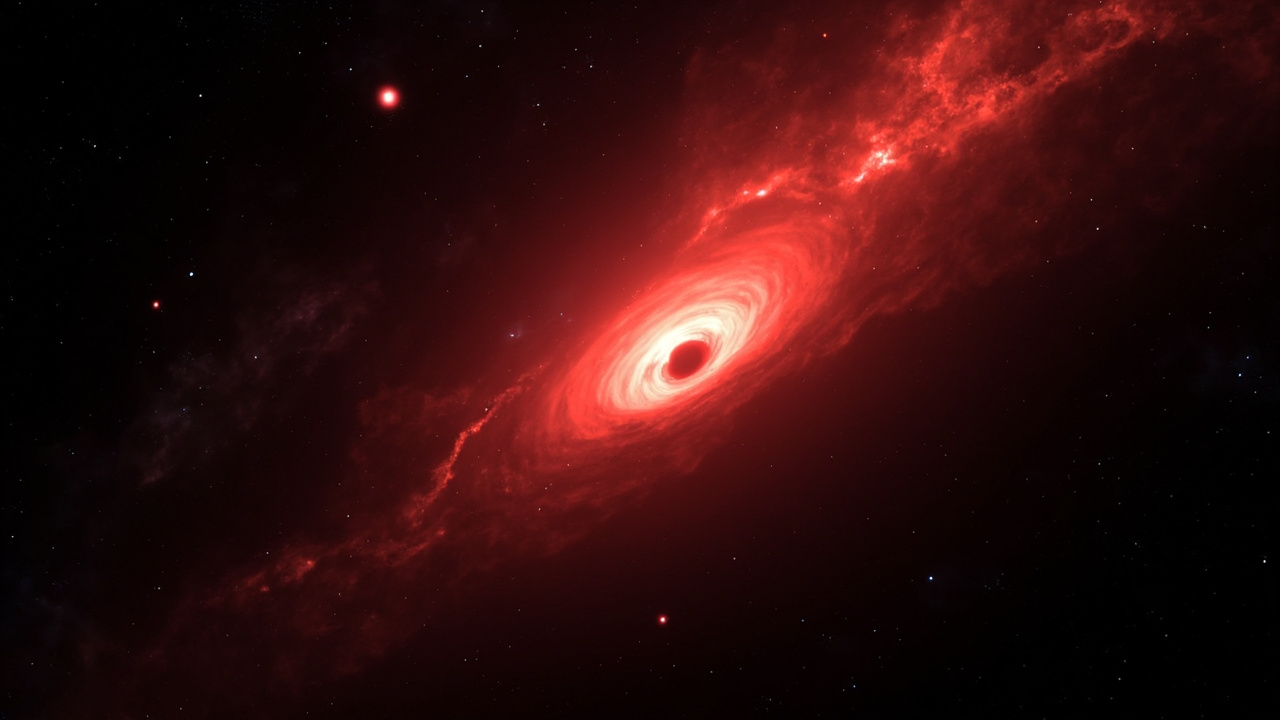
TL;DR: Astronomers identified MoM-BH*-1 as a black hole star — a black hole wrapped in dense hydrogen that looks like a star the size of the solar system.
A red dot that did not fit any known object
Astronomers working with James Webb Space Telescope observations concluded that an extremely red and very bright little red dot is a black hole star, according to Ars Technica. The name reflects its apparent size and power: it is the size of a large star but produces far more energy than would be possible via nuclear fusion, energy comparable to what an active black hole would produce.
The object is named MoM-BH*-1. The team described it in detail in a paper published in the journal Nature, according to Ars Technica. The paper carries DOI 10.1038/s41586-026-10846-4.
The finding addresses a long-running puzzle. Nearly every large galaxy keeps a giant black hole at its center, according to Earth.com. Some of those giants already weighed a billion Suns when the universe was less than 700 million years old. Astronomers have struggled for decades to explain how anything grew that heavy that fast.
A new study built on James Webb Space Telescope observations suggests one possible answer, according to Earth.com. The researchers describe a young black hole wrapped in gas so dense that the whole object shines like a single enormous star. Astronomers call objects like it black hole stars.
The light from this one has been traveling for 13 billion years, since a moment just 660 million years after the Big Bang, according to Earth.com. No earlier example has been found.
Discovery at cosmic dawn
In 2024, astronomers combing through datasets taken by the James Webb Space Telescope noticed hundreds of mysterious little red dots lurking therein, believed to be baby quasars, according to Ars Technica. They existed when the Universe was just a few hundred million years old.
One such object captured scientists' interest because it was extremely red and very bright, but its properties did not fit with any known astrophysical object, according to Ars Technica. That object became MoM-BH*-1.
The object turned up in a Webb survey called Mirage or Miracle, built to follow up risky sources that could be major discoveries or nearby look-alikes, according to Earth.com. The same survey confirmed the most distant galaxy known.
Rohan Naidu of the University of Hawai'i's Institute for Astronomy led the work with Jorryt Matthee of the Institute of Science and Technology Austria, according to Earth.com. In images covering a patch of sky about a third the size of the full Moon, this source was the reddest thing found. It glowed at Webb's longest infrared wavelengths and vanished in bluer light, all from a single point.
Matthee coined the nickname little red dots for a class of puzzling objects in Webb's images, according to Earth.com. Matthee was not expecting something far away at all. He told Earth.com that the first surprise was even the distance of the object.
From the first images, he said he would have guessed it was a brown dwarf, according to Earth.com. Those are dim, failed stars in our own Milky Way, and in pictures they can be mistaken for distant galaxies.
Little red dots were first detected in 2022 after NASA's James Webb Space Telescope began operations, according to DongA Science. Objects in the very distant early universe, which had been hard to see with the Hubble Space Telescope, started to come into view.
Light more than 20 times brighter on one side
The team split the object's light by wavelength and measured its brightness at each one, according to Earth.com. On the red side of one particular wavelength, the object shines more than 20 times brighter than on the blue side.
Astronomers call that kind of drop a Balmer break, and stars produce modest ones in their atmospheres, according to Earth.com. A population of ordinary stars cannot make a break stronger than about three on the scale astronomers use.
Even one built purely from the strongest-break stars would stay under five, according to Earth.com. This object measured 7.7.
Initially, the authors thought the object was so red because it was surrounded by dust, according to Ars Technica. While the light produced was extremely bright, it completely disappeared below certain wavelengths. This is known as a Balmer break and is usually a signature of a stellar atmosphere. But this was the deepest break ever observed.
Also, there was no evidence of metals or any element other than hydrogen and helium in the spectrum, according to Ars Technica. The spectrum shows something else: hydrogen gas absorbing light at several specific wavelengths, according to Earth.com. Gas needs to be extraordinarily dense to absorb light that way.
Before Webb, astronomers had seen that signature in just a handful of objects, every one of them hosting a supermassive black hole, according to Earth.com.
Dense hydrogen instead of dust
Red objects in space usually mean dust, which absorbs blue light, according to Earth.com. Here, the team traced the color to dense hydrogen gas instead.
The authors decided to run computer simulations to determine what could produce this unusual combination of features, according to Ars Technica. They reasoned that the red dot must be a powerful energy source surrounded by a very dense hydrogen cocoon.
The researchers modeled the source as a black hole roughly one million to ten million times the Sun's mass, according to Earth.com. In the model, a churning envelope of hydrogen surrounds the black hole, spanning tens of times the distance from Earth to the Sun — about the size of our solar system.
The envelope holds almost no dust, according to Earth.com. Dense gas reddens light passing through it without blocking the view, much like Earth's atmosphere reddens the Sun at sunset.
The only possible source capable of that degree of brightness, 100 billion times brighter than a star, would be an active accreting black hole, according to Ars Technica. The team concluded that MoM-BH*-1 is a black hole star: a massive central black hole surrounded by a dense cocoon of hydrogen the size of our solar system.
The spectrum detected is described as evidence of a cloak of gas feeding an early-forming black hole, according to Earth.com. Because of its spectrum and with a nod to the survey's name, the team dubbed the object MoM-BH*-1.
Growing past the normal feeding limit
Black holes have a feeding limit, according to Earth.com. Matter falling in heats up and glows, and that light pushes outward on everything still falling, which normally caps how fast a black hole can grow.
A thick envelope can change that, according to Earth.com. Theory predicts the gas traps the escaping light, so gravity overwhelms the outward push and the black hole grows past the usual limit.
Theoretical models have already predicted that early black holes embedded in dense gas can grow rapidly through what is called super-Eddington accretion, according to Earth.com. This black hole may be in the middle of such an episode, or near the end of one. The team cannot yet tell which.
The researchers also call their model simple and idealized — a way to build physical intuition, not a finished picture, according to Earth.com.
Astronomers hope the discovery of black hole stars — two more have since been identified — will help them solve the puzzle of how supermassive black holes formed so soon after the Big Bang, according to Ars Technica.
Connection to baby quasars
Webb has photographed hundreds of little red dots, according to Earth.com. Matthee called them baby quasars when his team described them in 2024, and researchers have written nearly a thousand papers and preprints about them since.
Their light arrives blended — the host galaxy and the central object mixed into a single point — so no one could study the center on its own, according to Earth.com. MoM-BH*-1 gives astronomers that view for the first time. Almost all of its light comes from the black hole and its envelope, leaving little room for a host galaxy's stars.
The object also has a brighter neighbor, a galaxy about 195,000 light-years away — roughly two Milky Ways laid side by side, according to Earth.com. The two are expected to merge within about 100 million years.
Stack the light of both together and the result looks like a typical little red dot, according to Earth.com. The galaxy dominates the blue end, and the black hole outshines it toward the red.
Matthee said that if embedded in similar host galaxies, black hole stars like MoM-BH*-1 might well serve as the central engines of baby quasars, according to Earth.com. In this picture, scattering in the gas — not fast-moving matter — is what broadens these objects' light.
Why host galaxies matter
Light that could plausibly originate from the vicinity of black holes has been observed in some little red dots, leading to debate over whether little red dots are extremely small and compact galaxies, gigantic black holes, or something else, according to DongA Science. Another reason their nature is unclear is that little red dots are so small and their centers so bright that they appear almost point-like in observational images.
An international team led by Wuhan University and Hunan Normal University examined the outskirts of little red dots by stacking 217 little red dot images and averaging them, according to DongA Science. Light from the outer regions beyond the center, which had been too faint to distinguish in individual images, appeared in a ring-like shape.
The researchers interpreted this peripheral light as being difficult to explain with a single central object alone and judged that it is more likely to be a signal from a host galaxy forming stars, according to DongA Science. They proposed that there may be a black hole at the center surrounded by a small galaxy. The average radius of galaxies around little red dots was estimated to be about 210 parsecs.
One parsec is roughly 3.26 light-years, according to DongA Science. Compared with the Milky Way, whose overall size spans tens of thousands of parsecs, the galaxies around little red dots are extremely small.
Jung Woong-seop, principal researcher at the Korea Astronomy and Space Science Institute, said scholars were quite surprised at first, according to DongA Science. He added that little red dots have become extremely important targets for studying how black holes and galaxies grew together in the early universe.
Jung said that if little red dots turn out to be growing black holes wrapped in thick gas, they can be considered as a previously hidden phase in black hole growth in the early universe, according to DongA Science. He added that little red dots may not all be the same type of object. They could be black holes growing behind veils of gas, small compact galaxies, or composite systems where both black hole activity and star formation are vigorous at the same time.
Jung said the greatest significance of little red dot studies is that they are connected to the question of whether black holes or galaxies grew first in the early universe, according to DongA Science. He added that little red dots may lie right on that boundary.
More precise observations will be needed to clearly determine what little red dots are, according to DongA Science. These include spectroscopic observations that split light by wavelength to examine the composition and motion of objects, and high-resolution imaging capable of separating the faint light from cores and surrounding galaxies.
Sources referenced
- Research roundup: 7 cool science stories we almost missed - Ars Technica (https://arstechnica.com/science/2026/09/august-research-roundup-7-cool-science-stories-we-almost-missed/)
- Giant black holes appeared too soon after the Big Bang, and astronomers may know why - Earth.com (https://www.earth.com/space/earliest-black-hole-star/)