TL;DR: Belgian-born physicist Francis Halzen won the solo 2026 Nobel Prize in Physics for conceiving and leading the IceCube Neutrino Observatory, which captured high-energy neutrinos from beyond the solar system.
Solo physics prize goes to neutrino hunter
The Royal Swedish Academy of Sciences decided to award the Nobel Prize in Physics 2026 to Francis Halzen of the University of Wisconsin–Madison, USA, according to NobelPrize.org. The citation was “for decisive contributions to the IceCube Neutrino Observatory and the discovery of high-energy neutrinos of astrophysical origin.”
The Academy announced the award in Stockholm on Oct. 6, 2026, according to NPR, which credited The Associated Press for its reporting. Halzen spoke to the Nobel Committee by phone from Italy on Tuesday, telling the committee it was a great surprise and that he obviously had not expected it. In Turin, Italy, he flashed a victory sign in his hotel after the announcement, according to AP News.
Halzen, born in 1944 in Tienen, Belgium, earned a PhD in 1969 from KU Leuven, Belgium, and is a professor at the University of Wisconsin–Madison, according to NobelPrize.org. He is 82 years old and affiliated with the University of Wisconsin–Madison, according to NPR. The BBC News reported that Halzen, who led development of IceCube at the South Pole, is now a U.S. citizen at the University of Wisconsin–Madison.
The prize amount is 12 million Swedish kronor, according to NobelPrize.org. That is about $1.2 million, whether for an individual, a small group or an organization, according to NPR.
Why IceCube changed astronomy
“Francis Halzen has led an international team of researchers and engineers who have provided us with a fantastic instrument. His tenacity and scientific vision has paved the way for a new kind of astronomy,” said Mark Pearce, chair of the Nobel Committee for Physics, according to NobelPrize.org.
The Royal Swedish Academy of Sciences said his vision and scientific leadership have been fundamental for the IceCube Neutrino Observatory, according to BBC News. Halzen realized that ice at the South Pole could be used to track particles known as neutrinos, according to NobelPrize.org. Using IceCube, researchers can capture neutrinos from extremely energy-rich processes in the distant universe.
Louis Barson, director of science at the Institute of Physics in London, said the IceCube Observatory had enabled astronomers to investigate phenomena that conventional telescopes cannot see, according to BBC News. He added that the discoveries that followed are helping understanding of some of the most energetic and mysterious processes in the universe. Subir Sarkar, a physicist from the University of Oxford, said Halzen had led the IceCube collaboration on a voyage of discovery and opened a new window onto the universe, according to BBC News.
Ghost particles that cross Earth unseen
Neutrinos are everywhere, but they do not make themselves known, according to NobelPrize.org. They pass all the way through the Earth and through our bodies without us noticing. Very rarely, a single neutrino will interact with an atomic nucleus, which makes it possible for someone with the right equipment to discover them.
Neutrinos are tiny cosmic particles with a mind-bogglingly small mass, according to NPR. They spew from stars like the sun and trillions zip through our bodies every second. Around 100 trillion neutrinos pass through the body every second, according to CERN, while the BBC News reported that every second, billions pass harmlessly through an area the size of a fingernail.
Scientists cannot glimpse the mysterious ghost particles on their own, according to NPR. Instead, they measure what happens when the tiny particles collide with other bits of matter, producing flashes of light or charged particles. When a neutrino collides with an atomic nucleus, it produces a flash of light that can be tracked by sensors in the clear glacial ice, according to NobelPrize.org.
On the rare occasions when a neutrino strikes an atomic nucleus, it produces fast-moving charged particles, according to BBC News. Racing through the ice, those particles give off a blue glow that sensitive light detectors can pick up. Because water is transparent, this light can be detected, and with the right equipment it is possible to determine the direction of the light's path and see where the neutrino came from, according to the Royal Swedish Academy of Sciences background material summarized by NSF reporting.
A cubic kilometre of Antarctic ice
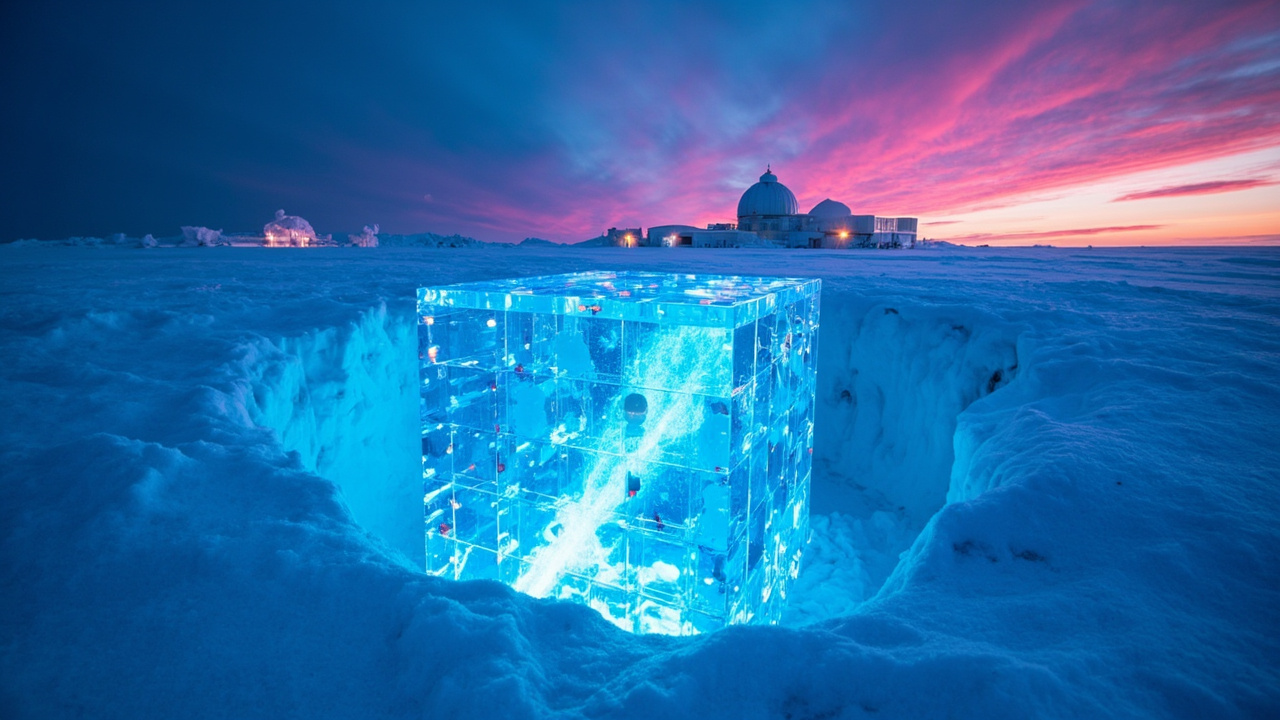
IceCube covers an entire cubic kilometre and was finished in 2011, according to NobelPrize.org. It uses a cubic kilometre of Antarctic ice fitted with light sensors to detect neutrinos, according to BBC News. It is composed of thousands of sensors on long cables that are drilled and frozen into a 1-kilometer cubic block of ice.
The U.S. National Science Foundation reported that Halzen and other scientists devised a plan to put thousands of digital detectors more than two kilometers deep in the crystal-clear ice of the South Pole. The detector consists of over 5,000 light sensors spread across a cubic kilometre of ice about two kilometres below the surface at the South Pole, according to CERN. The University of Wisconsin–Madison is its lead institution, and the facility is located at the South Pole in Antarctica, according to NPR.
The South Pole's ice has many advantages, as it is free from various types of interference and the area is geologically stable, with no earthquakes, according to NobelPrize.org. At great enough depth, darkness is constant, and unlike the ocean there is no interference from living creatures and there are only low levels of radioactive substances, according to the Academy's popular-science background. A research station was already located at the geographic South Pole, with an organization for regular transports and everything necessary for a team to work.
From 1988 idea to operating telescope
Francis Halzen first presented his vision for capturing neutrinos at the South Pole in 1988, according to NobelPrize.org. He first presented the concept for a neutrino observatory in the ice of the South Pole in 1988 at a conference in Poland, after discussions with research colleague John G. Learned, who was working on the DUMAND project aimed at capturing light signals in deep ocean water off Hawaii, according to the Academy background.
In the 1980s, while Halzen was working with cosmic particles, he heard that Soviet researchers were planning to use radio receivers to capture neutrino signals in Antarctica, according to that background account. Halzen was inspired and realized that another method could be to install light sensors in glacier ice and look for flashes of light from collisions. Around 1960, several physicists had suggested that water could be a good material for capturing neutrinos from space.
Halzen and his idea soon gained support from other researchers and, just a few years later, preliminary testing was conducted on sensors in ice, according to NobelPrize.org. In 1992, a group of researchers and engineers made the first attempts to lower light sensors into the glacier at the South Pole, according to the Academy background. When it was first proposed to NSF in the 1990s, IceCube was an ambitious vision for a scientific facility unlike any other, according to the NSF.
Construction began in 2004 at the NSF Amundsen-Scott South Pole Station with support from the NSF-managed U.S. Antarctic Program, according to the NSF. Over more than two decades, NSF invested in design, construction and ongoing operations of IceCube. Foundational science requires extraordinary grit from engineers, instrument builders and field crews who constructed and operate the observatory beneath Antarctic ice, said Brian Stone, performing the duties of NSF director, according to the NSF.
Discovery of cosmic high-energy neutrinos
Cosmic neutrinos with extremely high energies are very rare, so an enormous volume of ice is needed to observe an adequate number of collisions, according to NobelPrize.org. Researchers soon discovered the first high-energy neutrinos and, a few years later, could publish their discovery of neutrinos that must originate far outside the solar system.
In 2011, IceCube began operations and, two years later, published findings showing it had detected the highest-energy neutrinos ever observed, according to the NSF. Those neutrinos had more than a million times the energy of those previously detected, which provided the first evidence that neutrinos might be regularly passing through Earth from distant high-energy sources outside the solar system.
Halzen studied a rare group of neutrinos that scientists consider messengers from the cosmos, offering clues to how the universe evolved, according to NPR. His research into capturing neutrinos at the South Pole dates back to the 1980s. Scientists have long known that the cosmos contains natural particle accelerators, which fire out particles with energies up to a million times more than can be achieved in laboratories on Earth, according to NobelPrize.org.
Neutrinos with extremely high energies are created in the same environments as other types of particles, according to NobelPrize.org. However, unlike other particles, neutrinos reach Earth without changing direction or losing energy, providing information not available in any other way.
Messengers from black holes and galaxies
In the years since operations began, analysis of IceCube data has resulted in many more discoveries that expanded understanding of the universe, according to the NSF. Those findings include definitive evidence in 2018 of neutrinos coming from a supermassive black hole in another galaxy. In 2023, IceCube produced the first-ever neutrino-based image of the Milky Way.
The pattern and timing of the light allow scientists to estimate the direction the neutrino came from, helping trace its origins, according to BBC News. These rare signals carry clues to where neutrinos came from and the extreme conditions that produced them, allowing scientists to investigate places ordinary telescopes cannot easily see.
The neutrino's ghostly nature makes it a powerful messenger because neutrinos rarely interact with material in their path, so they can go through dense regions that light cannot easily penetrate, according to BBC News. Because they have no electric charge, magnetic fields do not bend their paths, so arrival direction can point back toward the source. Their energies help scientists investigate how exploding stars and environments around giant black holes accelerate particles to extraordinary energies.
The neutrino interactions continuously collected by IceCube will provide novel knowledge about violent settings where high-energy neutrinos can be created and could even reveal previously unknown cosmic phenomena, according to NobelPrize.org. Many results were made possible by NSF high-performance computing facilities used to process vast amounts of IceCube data and run simulations that helped interpret measurements with greater accuracy, according to the NSF.
“Very few thought it would work”
Halzen told a news conference that he was surprised his idea worked so well, according to BBC News. “I have to emphasise how lucky I was. Because when we started this project, everybody realised this was maybe a good idea, but very few thought it would work, including myself.” Halzen said it had been predicted before that he would win the Nobel Prize but the announcement still made him feel “strange,” according to NPR.
The announcements of the 2026 prizes began Monday with the Nobel Prize in medicine awarded to three scientists whose work led to a tool that uses light to help unravel how the brain works, according to NPR. Last year, three scientists won the physics prize for research on quantum tunneling that enabled ultra-sensitive measurements achieved by MRI machines and laid groundwork for better cellphones and faster computers.
This week's awards continued Wednesday with the chemistry prize and literature on Thursday, according to NPR. After Friday's peace prize, the Nobel Memorial Prize in Economic Sciences was scheduled to be announced on Monday.
Sources referenced
- Press release: Nobel Prize in Physics 2026 - NobelPrize.org (https://www.nobelprize.org/prizes/physics/2026/press-release/)
- Francis Halzen wins physics Nobel Prize for hunting ghostly neutrinos | AP News (https://apnews.com/article/nobel-prize-physics-sweden-47d0ab2b92f3512eb09ed44ceb6006d8)