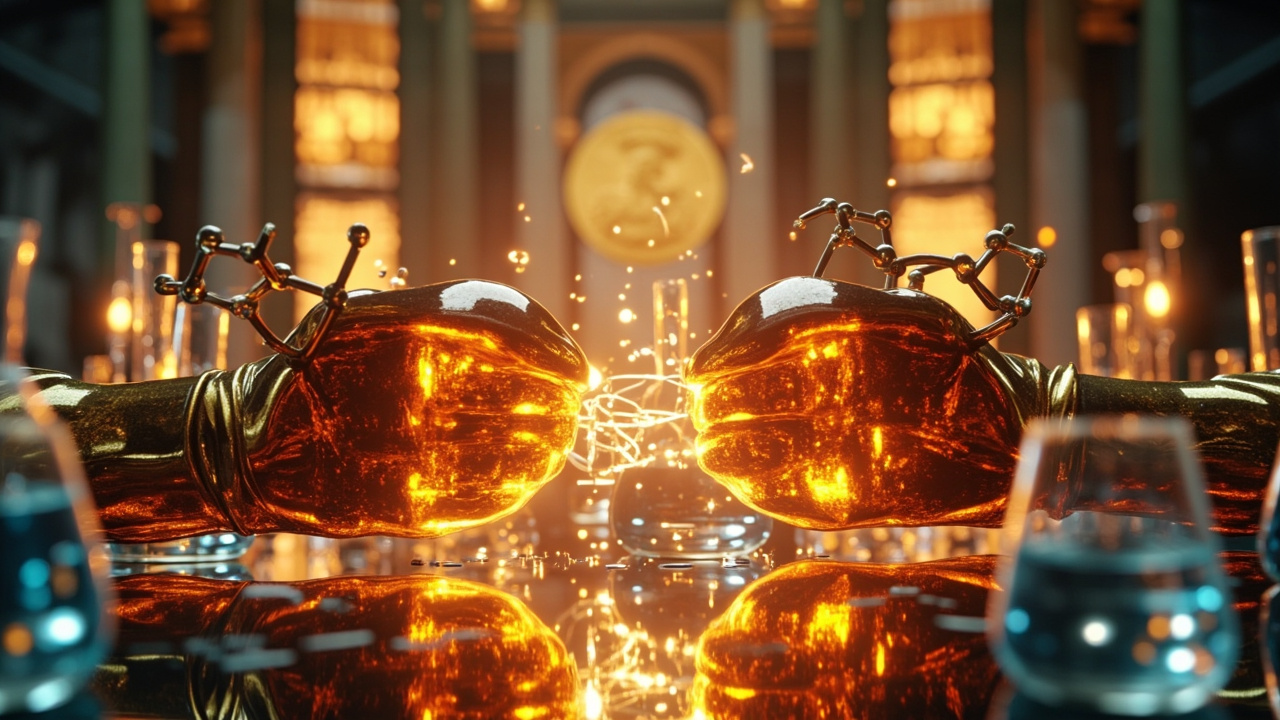
TL;DR: The Royal Swedish Academy of Sciences awarded the 2026 Nobel Prize in Chemistry to Henri B. Kagan and Kenso Soai for discoveries showing how chemical reactions can produce only one mirror-image molecule.
Academy names two laureates in Stockholm
The Royal Swedish Academy of Sciences decided to award the Nobel Prize in Chemistry 2026 to Henri B. Kagan of Université Paris-Sud in France and Kenso Soai of Tokyo University of Science in Japan, according to NobelPrize.org.
The announcement was made on 7 October 2026 in Stockholm, Sweden, according to Al Jazeera. The Academy cited the pair “for the discovery of non-linear effects and autocatalysis in asymmetric organic synthesis,” according to NobelPrize.org.
Kagan was identified as 95 and from France, while Soai was identified as 76 and from Japan, according to Al Jazeera. The prize amount is 12 million Swedish kronor to be shared equally between the laureates, according to NobelPrize.org.
Soai learned of the decision while away from home. He told the Nobel Prize news conference by telephone that he had been out shopping when he received the news, according to Al Jazeera.
“This is the most exciting day in my life, I am very glad to share this prize with Professor Henri Kagan,” he said, according to Al Jazeera.
Why mirror images matter for medicines
Some molecules, such as amino acids, exist as two variants that are each other’s mirror image, according to NobelPrize.org. Living organisms only contain one of these mirror images, according to NobelPrize.org.
Life’s chemistry is described as homochiral, after the Greek words for “same” and “hand,” according to NobelPrize.org. Like hands, all amino acids exist as two mirrored variants, but only one is found in the proteins in cells, according to NobelPrize.org. The other is rarely found in nature, according to NobelPrize.org.
Many molecules essential to life exist in two forms that mirror each other like left and right hands, yet living organisms almost exclusively use only one version, according to Al Jazeera. That single-handed preference puzzled chemists for more than a century, according to Al Jazeera.
The practical stakes involve pharmaceuticals. Chemists sought to produce only one mirror image because, in development of molecules that interact with living beings — such as in pharmaceuticals — only one mirror image will have the desired effect, according to NobelPrize.org.
Peter Somfai, a member of the Nobel Committee for Chemistry, explained the manufacturing problem in drug development, according to Al Jazeera.
“The left-handed version of the drug can have one effect, and the right-handed version can have another effect, and then we need methods for selectively preparing them,” Somfai said, according to Al Jazeera.
He added that the laureates’ findings supplied important methods for that work, according to Al Jazeera.
“In developing such methods, the findings of this year’s laureates are important. They provided powerful tools for that,” he said, according to Al Jazeera.
Kagan’s 1986 step toward selective synthesis
Henri Kagan took the first decisive step in 1986, when he discovered a new way of manipulating chemical reactions, according to NobelPrize.org. That approach allowed him to create a greater excess of one mirror image than had previously been thought possible, according to NobelPrize.org.
Before that advance, chemists experimenting with reactions that could form two mirrored molecules always obtained equal proportions of both in test tubes, according to NobelPrize.org. Kagan’s result showed that imbalance could be pushed further toward one variant, according to NobelPrize.org.
The Nobel Prize in Chemistry 2026 recognizes discoveries that enabled chemists to drive chemical reactions that lead to homochirality, according to NobelPrize.org. Those discoveries have been decisive for chemists who design reactions for the manufacture of pharmaceuticals, according to NobelPrize.org.
Heiner Linke, chair of the Nobel Committee for Chemistry, placed the work in a long historical context, according to NobelPrize.org.
“Henri Kagan and Kenso Soai have provided a solution to a chemical mystery that is over a century old: how homochirality can emerge spontaneously. The chemical reactions they have developed are spectacular,” Linke said, according to NobelPrize.org.
Linke also described the laureates as providing an answer to how single-handed chemistry can appear without living control, according to Al Jazeera. Al Jazeera reported his assessment that the two scientists offered a solution to a chemical mystery more than a century old and called the reactions they developed spectacular.
Soai’s 1995 design and 2003 single-image reaction
Kenso Soai took the next step after Kagan, according to NobelPrize.org. In 1995, a key publication describes how he designed the first ever chemical reaction that had the potential to be homochiral, according to NobelPrize.org.
In 2003, he finally succeeded, according to NobelPrize.org. He presented a reaction in which only one of the two possible mirror images was formed, according to NobelPrize.org. Other than life itself, no one had previously achieved that feat, according to NobelPrize.org.
Their findings showed how chemical reactions can be driven to favour a single molecular mirror image, according to Al Jazeera. That capability has been key for chemists who design reactions for pharmaceutical manufacturing, according to Al Jazeera.
Thanks to Kagan and Soai, researchers now know how homochirality can emerge, according to NobelPrize.org. The Academy summarized the achievement with the heading “They made chemistry choose a mirror image,” according to NobelPrize.org.
Who the laureates are
Henri B. Kagan was born in 1930 in Boulogne-Billancourt, France, according to NobelPrize.org. He received a PhD in 1960 from Collège de France in France, according to NobelPrize.org. He is Professor Emeritus at the then Université Paris-Sud in France, according to NobelPrize.org.
Kenso Soai was born in 1950 in Hiroshima, Japan, according to NobelPrize.org. He received a PhD in 1979 from the University of Tokyo in Japan, according to NobelPrize.org. He is Professor Emeritus at Tokyo University of Science in Japan, according to NobelPrize.org.
The Academy listed Kagan with Université Paris-Sud, France, and Soai with Tokyo University of Science, Japan, according to NobelPrize.org.
Place in Nobel week
The chemistry Nobel is the third prize awarded during Nobel week, following those for medicine and physics, according to Al Jazeera. The literature laureate was to be revealed on Thursday, while the peace prize was due on Friday, according to Al Jazeera.
Last year’s chemistry award went to scientists Susumu Kitagawa, Richard Robson and Omar Yaghi for development of metal-organic frameworks, molecular constructions that can help tackle challenges such as climate change and lack of freshwater, according to Al Jazeera.
The prizes for achievements in science, literature and peace were established in the will of Swedish inventor and businessman Alfred Nobel and have been awarded since 1901, with a few interruptions mostly due to the world wars, according to Al Jazeera. Nobel, a chemist by trade, amassed wealth in the 19th century from inventions primarily tied to warfare, most notably dynamite, according to Al Jazeera. The economics prize is a later addition funded by the Swedish central bank, according to Al Jazeera.
Further information was listed at www.kva.se and www.nobelprize.org, according to NobelPrize.org.
Sources referenced
- Press release: Nobel Prize in Chemistry 2026 - NobelPrize.org (https://www.nobelprize.org/prizes/chemistry/2026/press-release/)
- Henri Kagan, Kenso Soai win Nobel chemistry prize for ‘mirror image’ work | Science and Technology News | Al Jazeera (https://www.aljazeera.com/news/2026/10/7/henri-kagan-kenso-soai-win-chemistry-nobel-for-mirror-image-breakthrough)