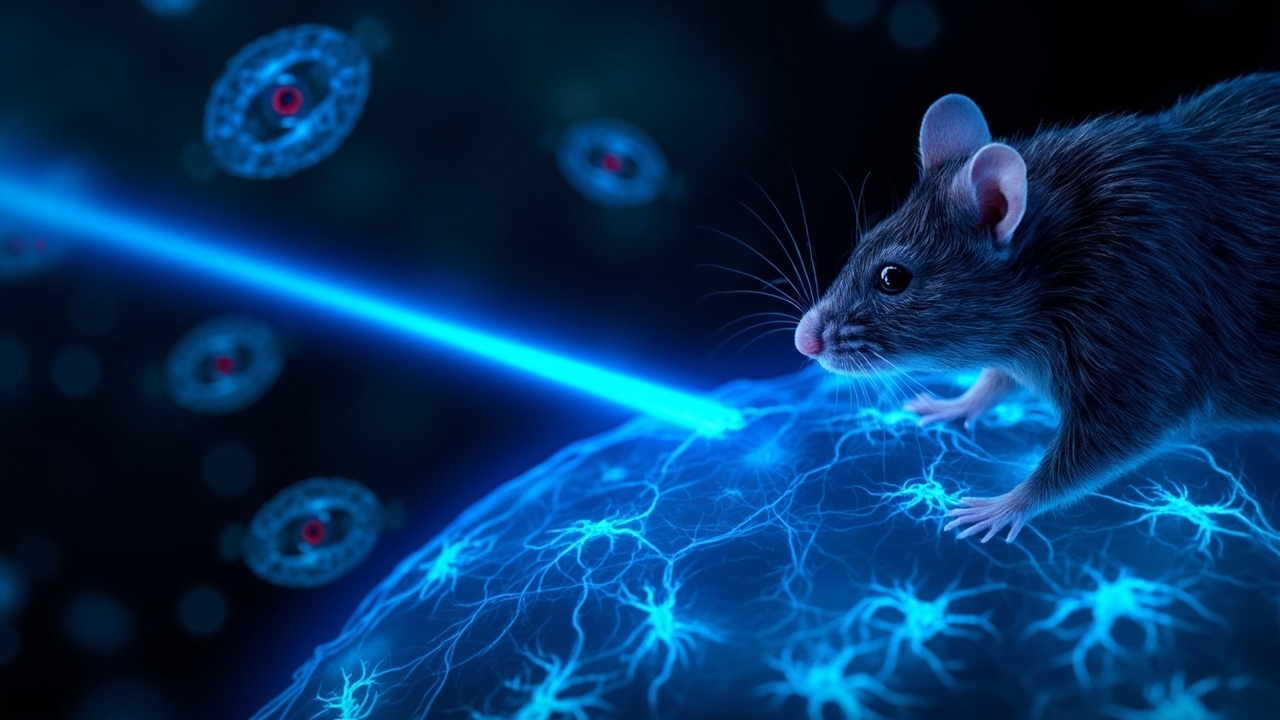
TL;DR: Light became a remote control for brain cells.
The Nobel Assembly at Karolinska Institutet awarded the 2026 Nobel Prize in Physiology or Medicine on 5 October 2026 jointly to Karl Deisseroth, Peter Hegemann and Georg Nagel for discoveries concerning light-gated ion channels and optogenetics, according to NobelPrize.org.
The method lets researchers switch activity on or off in individual nerve cells in a living brain with pulses of light. Hegemann and Nagel found the light-sensitive protein channelrhodopsin in a single-celled alga in the early 2000s. Deisseroth inserted its gene into mammalian nerve cells, published that nerve-signal result in 2005, and extended the switch to the brains of living mice two years later. The three share 12 million Swedish kronor equally, listed by Nature as US$1.2 million.
A prize announced in Stockholm
Thomas Perlmann, secretary-general of the Nobel Assembly, announced the winners on 5 October 2026 at Karolinska Institutet in Stockholm. The formal citation was for discoveries concerning light-gated ion channels and optogenetics, according to NobelPrize.org.
The laureates named were Karl Deisseroth of the Howard Hughes Medical Institute and Stanford University in the United States, Peter Hegemann of Humboldt University of Berlin in Germany, and Georg Nagel of the University of Würzburg in Germany.
Deisseroth was born in 1971 and earned a Ph.D. in 1998 and an M.D. in 2000 from Stanford University, where he is D.H. Chen Professor and Professor of Bioengineering and of Psychiatry and Behavioral Sciences. Hegemann was born in 1954 and earned a Ph.D. in 1984 at the Max-Planck-Institute for Biochemistry in Martinsried, Germany, and is Hertie Senior Professor of Neuroscience at Humboldt University of Berlin. Nagel was born in 1953 and earned a Ph.D. in 1988 at the University of Frankfurt, Germany, and is Professor of Molecular Plant Physiology at Würzburg. The prize discoveries were made at Martinsried for Hegemann and at the Max Planck Institute for Biophysics in Frankfurt for Nagel, according to NobelPrize.org.
Nature reported ages on prize day as Deisseroth 54, Hegemann 71 and Nagel 73, and that the award had been anticipated on many scientists' shortlists for years because the technique had transformed study of cause and effect in the brain.
Why brain researchers needed a better switch
Neuroscientists aim to explain how the brain governs feelings, behaviours and bodily functions. During the 20th century, investigators linked brain areas to functions but could not prove causal relationships with the tools then available, leaving a sketch map with many unknowns, according to NobelPrize.org.
Older genetic approaches identified genes active in neuron groups and mapped where those cells lived. Deleting those cells with genetics sometimes hinted at function, and injured brains offered additional clues. Yet the brain can adapt to cell loss, and removal early in development can change how connected cells mature, as Ars Technica explained.
Activating and silencing cells in an otherwise intact brain would be more informative. Per Svenningsson, Chair of the Nobel Committee for Physiology or Medicine, said in the announcement: “Optogenetics provides opportunities for mapping the brain in a way that we could once only dream of.”
Earlier attempts to command neurons encountered practical barriers. According to Ars Technica, several pre-optogenetics approaches required inserting multiple genes, adding particular chemicals to nerve cells, or using lasers intense enough to injure cells, so none came into wide use.
An eyespot in pond algae held the answer
The starting point was curiosity about Chlamydomonas, a single-celled alga that swims toward a light source. The cell carries two flagella for movement and an eyespot that detects light, and it had already served as a model for basic biological processes, as Ars Technica explained.
Hegemann, then working at Humboldt University in Berlin, and coworkers connected an electrode to Chlamydomonas and found that a flash of light produced a very rapid influx of ions, pointing to a light-opened ion channel. When other groups catalogued messenger RNAs made by the alga, Hegemann noticed two genes resembling a light-activated ion pump known from an archaeal species.
He tested the link with RNA interference to block those genes. Light-triggered ion flow declined, implicating the genes in light sensing, according to Ars Technica.
Hegemann then entered an extended collaboration with Nagel, then at the University of Würzburg and a specialist in ion fluxes. They showed that one gene admitted mainly protons, understood as hydrogen ions, while the other passed a broader range of positively charged ions. The two proteins responded to somewhat different wavelengths of light and used a chemical relative of Vitamin A to sense light, the same family of chemistry used by receptors in human eyes. The group is now termed channelrhodopsins.
NobelPrize.org summarized the core property in functional terms: when illuminated by blue light, a channel opens through the protein, charged ions flow into the cell to create an electrical impulse, and cells receiving the protein became light sensitive regardless of cell type.
From frog eggs and worms to rat neurons
Nagel helped establish that channelrhodopsin genes could operate well outside algae. He showed function in settings ranging from developing frog embryos to cultured human cells, according to Ars Technica. When the proteins were active in neurons of the small worm C. elegans, light exposure changed worm behaviour.
NobelPrize.org likewise noted that Hegemann and Nagel discovered channelrhodopsin in the early 2000s and found broad transferability across cell types.
Deisseroth then adapted the system for mammalian neurons at Stanford. He introduced the gene for channelrhodopsin into nerve cells from rats. Illumination with blue light triggered a nerve signal. He published that breakthrough in 2005, according to NobelPrize.org.
Nature reported that Deisseroth and colleagues inserted the gene encoding channelrhodopsin into neurons of rodents and observed firing and communication with other neurons. The combination of genetics with a light-controlled switch soon became known as optogenetics.
Stanford Medicine reporting on the work said Deisseroth began the optogenetics project in 2004 with a pair of graduate students. The team delivered opsin-encoding genes into rodents' nervous tissue with viruses, limited production to neurons or even a selected neuron type, and observed the proteins appearing on nerve-cell surfaces where impulse traffic occurs. Deisseroth said funding reviewers often rejected the idea, reasoning that it would already have been done if it could work, because opsins had been known for decades.
Engineering light delivery inside moving animals
Making neurons light-responsive solved only part of the problem. Researchers also needed to shine light inside a living, behaving animal without restraining it.
Deisseroth and coworkers developed compact light sources and small, flexible fiber optics that could act in the brains of animals free to move and behave relatively normally, according to Ars Technica. Stanford Medicine described fine fiber-optic cables surgically implanted in the brains of living animals, allowing behaviour to change at the flip of a switch through pulses of laser light.
The protein toolkit also expanded. The Stanford group identified additional members of the channelrhodopsin family sensitive to different wavelengths of light. A version permitting negatively charged chlorine ions to enter cells was also discovered, giving researchers a way to selectively shut nerve cells down, according to Ars Technica.
Opsins, as Stanford Medicine described them, are pore-like proteins that open for particular wavelengths, letting currents of electrically charged particles move inward or outward across cell surfaces depending on opsin type.
Deisseroth described the operational gain in a statement quoted by Nature: “We use light to turn on or off individual cells, or even types of cell or connections from one part of the brain to another. We can turn those on and off with millisecond precision in real time during behaviour, during cognition, and that allows us to see what actually matters for brain function and to start to map function and dysfunction precisely.” He called the work a confluence of engineering and medicine.
What optogenetics changed for medicine and neuroscience
By 5 October 2026, optogenetics was in routine use in thousands of laboratories worldwide, according to Stanford Medicine. Using a mouse gene active in a small nerve-cell group, researchers can direct channelrhodopsin to that same group and then drive or suppress those cells during behaviour, Ars Technica explained.
NobelPrize.org said researchers had revealed neural circuits for specific memories, feelings and behaviours relevant to neurological and psychiatric disorders. In clinical medicine, groups were attempting to use the method to restore sight in people with visual impairment.
Nature reported that insights from optogenetic tools had helped studies of healthy brain function and conditions including depression, schizophrenia, Parkinson's and Alzheimer's. Rui Costa, president and chief executive of the Allen Institute in Seattle, Washington, said the laureates' work fundamentally changed how neuroscience is conducted, influenced wider biology and opened new therapeutic possibilities, while also crediting Deisseroth's large-scale sharing of tools and reagents. Alexander Gottschalk, a neuroscientist at Goethe University Frankfurt in Germany, called it an easy and precise way to select which cells become responsive and said many in the field had expected Nobel recognition for several cycles.
Deisseroth learned of the prize after working late. Describing himself as a night owl, he told a Stanford University press conference quoted by Nature: “It was a complete surprise.” He said he had been lying down and beginning to drift off when the telephone rang at his bedside, adding: “There were about 30 seconds where I had trouble forming words.”
Sources referenced
- Press release: Nobel Prize in Physiology or Medicine 2026 - NobelPrize.org (https://www.nobelprize.org/prizes/medicine/2026/press-release/)
- Controlling the brain with light earns a physiology Nobel - Ars Technica (https://arstechnica.com/science/2026/10/controlling-the-brain-with-light-earns-a-physiology-nobel/)