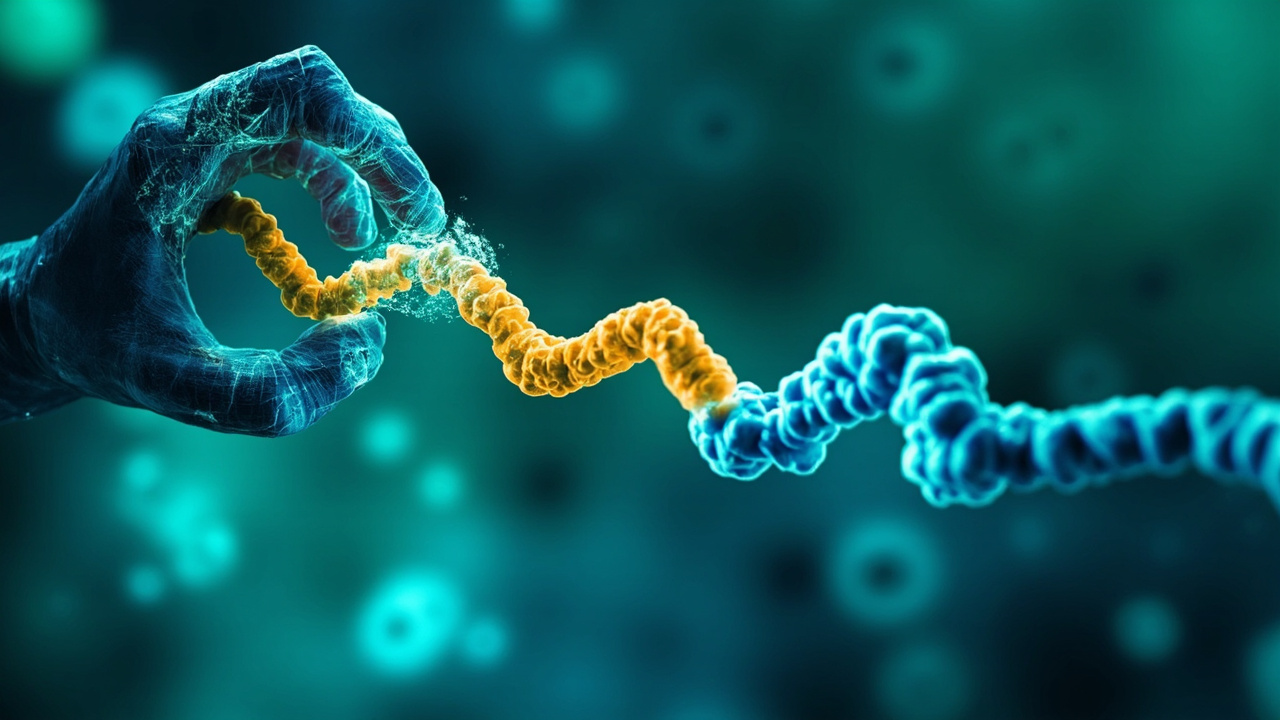
TL;DR: On Oct. 14, University of Washington researchers reported two AI-designed protease families in Nature that cut chosen disease-linked protein sequences millions to billions of times faster than uncatalyzed reactions.
AI-Designed Molecular Scissors Cut Disease Proteins at Chosen Sites
Researchers at the University of Washington Medicine Institute for Protein Design have computationally designed synthetic proteases that cut other proteins at precise, chosen points, with results published Oct. 14 in the journal Nature. According to reporting from UW Medicine Newsroom, the work was presented in two studies that specified target sequences, built enzymes to cut those targets, and verified cutting accuracy across experimental settings.
The tests covered purified proteins, sequences drawn from proteins implicated in Alzheimer's disease and amyotrophic lateral sclerosis, and, in one study, living human cells cultured in the lab. According to reporting from Ars Technica, the teams tuned the enzymes to cut specific proteins and demonstrated effectiveness by cutting proteins associated with neurological diseases.
Institute director David Baker, professor of biochemistry at the University of Washington School of Medicine and Howard Hughes Medical Institute Investigator, said the advance moves the field beyond prediction and building shapes. According to UW Medicine Newsroom, he said:
"The field is maturing from predicting and accurately building protein shapes and interactions to designing machinery that physically changes matter at the atomic level, in targeted and programmable ways."
He described the result as a major step forward for protein design.
Why cutting differs from binding drugs
Most medicines work by binding, in which a small molecule or antibody latches onto its target and holds on, blocking or activating it one molecule at a time. According to UW Medicine Newsroom, that one-to-one relationship dictates the medication limit, requiring a million or more copies of drug to engage a million copies of disease target.
That demand is largely why many protein medicines must be given in substantial quantities by infusion, familiar to patients who spend hours receiving intravenous fluids or who live with an implanted vein-access port. Enzymes operate on a different scale because an enzyme changes its target and releases its hold, unchanged and ready to act again.
A single designed protease can cut thousands to millions of specified targets over its lifetime, according to UW Medicine Newsroom. That turnover allows the same effect at a substantially lower dose than a binder that is consumed in a one-to-one interaction.
The functional properties also enable therapeutic approaches that would be impossible with a binding agent. According to UW Medicine Newsroom, those potential uses could include destroying a viral protein or a bacterial toxin outright, clearing a misfolded protein that accumulates in neurodegenerative disease, or snipping a protective cap off a drug so it functions only in the tissue where it is needed.
The advancement also opens the door to targeting disease-related proteins traditionally considered undruggable because they offer no pocket for a conventional drug to latch onto, according to UW Medicine Newsroom.
The hard chemistry problem
A protein is a chain of amino acids held together by peptide bonds. On their own, those bonds are extremely stable, with an estimated half-life of several hundred years, according to Ars Technica. In neutral aqueous solution, amide bonds linking amino acids along the backbone are stable for hundreds of years because of the high energy barrier to hydrolysis.
Organisms have evolved a handful of ways to catalyze breakup of peptide bonds, which have diversified into countless specialized protein-digesting enzymes. Proteases are everywhere and generally make short work of proteins that find their way into the environment.
Breaking a peptide bond reverses its formation by breaking apart the peptide bond and a water molecule and linking their parts. Because both components are chemically stable, the reaction requires an enzyme to occur with any frequency. Without an enzyme, a typical peptide bond would be stable for hundreds of years in water, according to Ars Technica.
The new work relied on two catalytic mechanisms. One is a zinc protease, where the positive charge of the zinc atom coordinates the peptide bond being broken, key parts of the protease, and a water molecule. The protease partially pulls a proton off the water molecule, activating it to attack and break the peptide bond.
The second is a cysteine protease. In that case, a cysteine in the enzyme is activated to attack the peptide bond, creating a temporary intermediate where part of the protein being cut is chemically linked to the enzyme. A water molecule eventually breaks this intermediate apart, releasing the second part of the cut protein.
Both mechanisms require a handful of specific amino acids to be located in close proximity within the catalytic center. Other amino acids help bring those key catalytic amino acids together with correct placement and orientation. The rest of the protease may enforce specificity. Some digestive proteases can cut next to any amino acid, others prefer positively or negatively charged amino acids, and a few are highly specific, such as the protease that activates insulin, which only cuts near a very specific series of amino acids, according to Ars Technica.
How RFdiffusion2 and ProteinMPNN built new backbones
The teams, primarily from Nobel-winner David Baker's lab at the University of Washington, treated protease design as a challenge because peptide-bond stability demands an effective catalyst and an extremely precise arrangement of amino acids. According to Ars Technica, it was not obvious that the lab's AI protein design tools were up to the task.
Both projects started with an existing protease, as evolution does. One was a zinc protease used in a crayfish's digestive system. The other was a cysteine protease from yeast. In both cases, the protein structure was known, as were the key amino acids that catalyze cleaving other proteins. The design process started with those amino acids, according to Ars Technica.
The design process started with software called RFdiffusion2, which creates a backbone for the enzyme from the protein's repeated peptide bonds. Researchers gave RFdiffusion2 constraints requiring any designed backbone to bring together the key catalytic amino acids for a functional protease. They also supplied a target amino acid sequence where the protease would eventually cut, requiring the backbone to accommodate that target in close proximity to the catalytic center.
With a backbone laid out, the process moved to ProteinMPNN, which populates the backbone with specific amino acids. According to Ars Technica, ProteinMPNN selects each amino acid based on compatibility with folding into the planned structure, compatibility with formation of the catalytic site in critical areas, and compatibility with latching onto the intended target in nearby areas.
Researchers then used deep-learning-based methods to develop structures, screened them for ability to cut a specific target sequence, and confirmed that structures matched computational blueprints, according to UW Medicine Newsroom. The design had previously remained elusive because the blades need near-atomic precision and natural proteases rely on subtle flexibility to grip their target sequence.
Cysteine proteases: 19% success and activity in cells
The paper titled De novo design of cysteine proteases, led by Hojae Choi, built enzymes around an activated cysteine blade. According to UW Medicine Newsroom, the researchers achieved a 19% success rate and cut their target sequence up to 30 million times faster than the uncatalyzed reaction.
The Nature abstract reports a success rate of 13 of 69, equal to 19%, and rate enhancements over background, measured as kcat over kuncat, of up to 3 times 10 to the 7th power. The designed proteases have folds very different from proteases in nature, with TM score less than 0.50, and six crystal structures were very close to design models, with C-alpha root mean squared deviation of less than 1.2 angstroms.
Experimental and computational analyses suggest the remaining gap to the most active native cysteine proteases arises from imperfections in active-site preorganization and substrate positioning. The designed proteases efficiently cleave their targets in mammalian cells, opening the door to synthetic biology applications.
Hojae Choi, a Ph.D. student in biochemistry at the University of Washington School of Medicine and lead author of one study, said designing proteases from scratch has been a longstanding challenge. According to UW Medicine Newsroom, he said the team created entirely new cysteine proteases that cleave chosen bonds specifically and work inside living cells, calling it a step toward tailor-made molecular scissors.
Metalloproteases: 36% success and Alzheimer's target
The paper titled Computational design of metalloproteases, led by Anqi Chen and Kejia Wu, designed proteases that use a bound metal ion rather than an amino acid as the cutting blade. According to UW Medicine Newsroom, 36% of designs showed activity and precisely cut amyloid-beta, a protein implicated in Alzheimer's disease, 100 million times faster than the uncatalyzed reaction.
The Nature abstract reports testing 135 designs, with 36% catalyzing cleavage of cognate peptide substrates at the targeted scissile bond. The work used RFdiffusion methods to design proteins with water-activating zinc-based active sites adjacent to a peptide substrate binding pocket.
The best design accelerates peptide-bond hydrolysis by more than 10 to the 8th power relative to the uncatalyzed reaction. Four substitutions increase that acceleration to more than 10 to the 10th power by improving active-site preorganization, according to the Nature abstract.
The approach was also used to design metalloproteases that selectively cleave the human disease-associated proteins TDP-43, amyloid-beta and serum amyloid A, with rate enhancements of up to 10 to the 9th power. The team further designed caged cytokines and receptor antagonists selectively activated by the designed proteases, enabling bioorthogonal control of cell state.
Anqi Chen, a postdoctoral scholar at the University of Washington School of Medicine and co-lead author, said proteases are just the beginning. According to UW Medicine Newsroom, she said the team envisions a new generation of designed molecules that can act on biological systems in increasingly sophisticated ways.
What comes next for programmable cutting
The researchers stated that de novo design can yield highly active, programmable proteases with applications in therapeutics, biotechnology and bioremediation. The support came from the Howard Hughes Medical Institute, Audacious Project, Open Philanthropy Project Improving Protein Design Fund, Schmidt Family Foundation, Wu Tsai Translational Investigator Fund, and others listed in the papers, according to UW Medicine Newsroom.
Atomic coordinates and structure factors for the cysteine work are publicly available through the RCSB Protein Data Bank under accession codes 9YNL, 9YNM, 9YOX, 9YOY, 9YOZ and 9YP0. Crystal structures for the metalloprotease work were deposited under accession codes 11CE, 11CM, 11CP, 11CR, 11CU, 11CY and 11DU.
Sources referenced
- Molecular ‘scissors’ open path to new therapies - UW Medicine | Newsroom (https://newsroom.uw.edu/news-releases/molecular-scissors-open-path-to-new-therapies/)
- Researchers use AI to design proteins that cut up other proteins - Ars Technica (https://arstechnica.com/science/2026/10/researchers-use-ai-to-design-proteins-that-cut-up-other-proteins/)