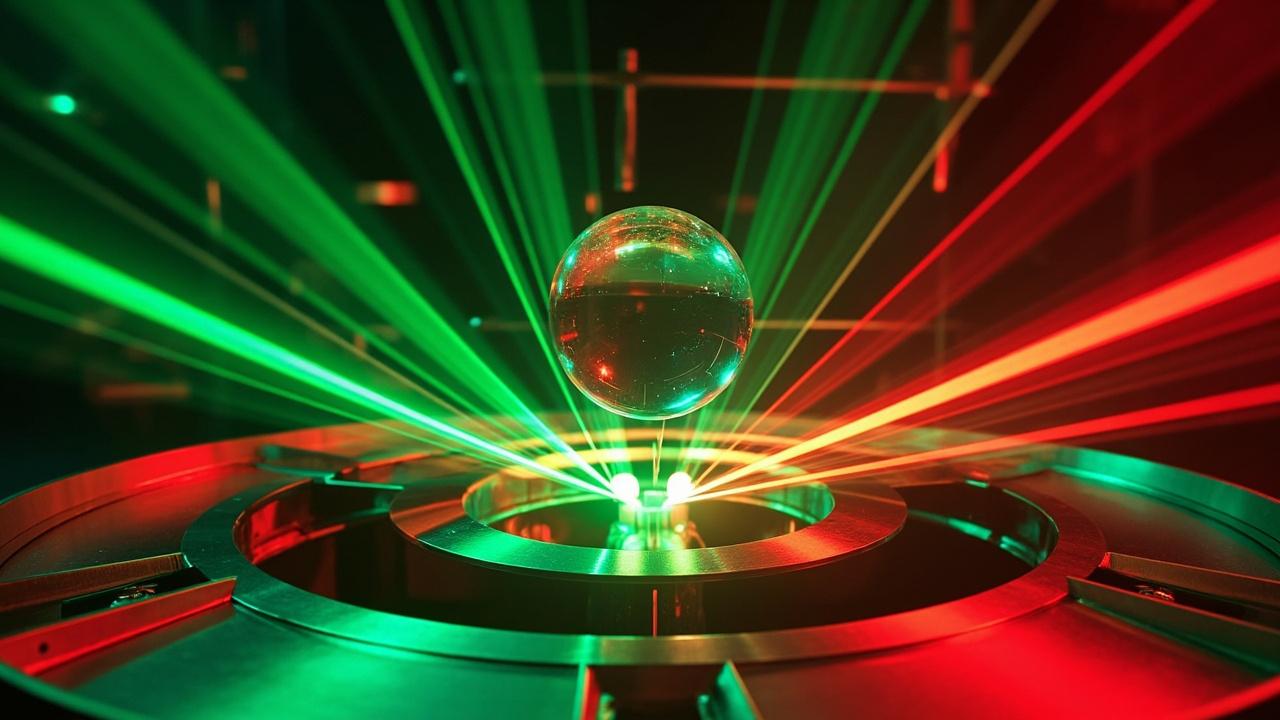
TL;DR: Physicists in Florence entangled the motion of a 100-nanometre glass sphere with light leaving an optical cavity, at room temperature and in steady state.
What the Florence team demonstrated
Researchers from the Department of Physics and Astronomy at the University of Florence and Italy's National Institute of Optics, CNR-INO, with support from INFN and LENS, reported observation of stationary entanglement between the motion of a glass nanosphere and light transmitted through an optical cavity, according to CNR – Istituto Nazionale di Ottica.
The result appeared in the journal Science as article doi:10.1126/science.aeh1375, with Francesco Marin as corresponding author and Quentin Deplano, Antonio Pontin and Francesco Marino as co-authors, according to CNR – Istituto Nazionale di Ottica. Marin is a lecturer in Experimental Physics of Matter at the University of Florence, while Deplano is affiliated with the university and Pontin and Marino are affiliated with CNR-INO.
Ars Technica described the work on Oct. 8 as getting a glass bead to act like a quantum object by linking it with a light beam, calling the measurement a substantial laboratory accomplishment.
Why entangling a bead is unusual
Entanglement means two or more particles become linked so that a measurement on one fixes the state of the other, even across an enormous separation, in a way that defies classical physics, according to CNR – Istituto Nazionale di Ottica.
Ars Technica explains the same idea as linked behavior producing correlations, using photons as an illustration: two photons can be uncorrelated in polarization yet strongly correlated in energy. In that picture, a single photon divided in two yields offspring whose individual energies are uncertain but whose total must match the parent, so reading one fixes the other.
The difficulty grows with size. Ars Technica notes that larger objects interact more strongly with their surroundings, and that interaction acts like measurement and erases fragile correlations almost as soon as they form. That is why a link involving a glass bead would normally be washed out before detection.
Creating such a link between light and the movement of a material object has long been a goal of quantum optomechanics, the study of light coupled to mechanical motion, according to CNR – Istituto Nazionale di Ottica.
The levitated particle at the center
The experiment used a glass sphere approximately 100 nanometres in diameter, held suspended in vacuum by optical tweezers, a tightly focused laser beam, and placed inside an optical cavity made from a pair of mirrors, according to CNR – Istituto Nazionale di Ottica.
The setup was maintained at room temperature, without elaborate cryogenic equipment, according to CNR – Istituto Nazionale di Ottica. That detail matters because earlier routes toward mechanical entanglement often depended on cooling near absolute zero.
Ars Technica reports that the bead sat near the center of the cavity, where laser light confined between the mirrors defines the optical fields. The mirror spacing sets phase and frequency and establishes fixed regions of high and low intensity.
How the optical cavity shapes the interaction
The cavity produces a standing-wave pattern, with alternating bright and dim zones between the mirrors, comparable to the fixed vibration pattern on a guitar string, according to Ars Technica. That spatial structure makes the coupling between bead position and light highly specific.
That specificity only holds if the particle stays close to one location. Ars Technica notes that limited motion keeps the bead-light interaction well defined, which is one reason the researchers cooled the particle.
The bead therefore had to be both levitated and calmed. Levitation isolated it from supports, while confinement by light left a residual back-and-forth vibration that the team then reduced.
Cooling without a refrigerator
Cooling here does not mean refrigeration. Ars Technica describes the optical trap as more like elastic bands than metal tweezers: the bead vibrates inside the beam, and that motion represents heat.
To cool it, the team slowed that vibration toward the quietest motion allowed, recognizing that perfect stillness is impossible, according to Ars Technica. The method shifted laser light slightly toward a redder frequency so the moving bead consistently surrendered energy through the Doppler effect.
In that process, light scattered from the bead gained a small amount of energy taken from the particle, according to Ars Technica. The exchange damped the motion and stabilized the bead for the quantum measurement that followed.
Two lasers with complementary jobs
One laser alone could not both stabilize and entangle. CNR – Istituto Nazionale di Ottica reports that the Florence apparatus employed two different lasers: one cooled and stabilized the motion, while the other generated the quantum correlations behind entanglement.
Ars Technica similarly describes a sequence in which cooling first prepares a nearly still bead, after which light must disturb it in a carefully controlled way to establish the link. The separation of functions prevented the entangling beam from shaking the particle out of its useful regime.
Support came from Italian research infrastructure. CNR – Istituto Nazionale di Ottica says the work drew on the National Institute for Nuclear Physics, INFN, and the European Laboratory for Non-linear Spectroscopy, LENS, alongside the Florence physics department and CNR-INO.
Funding was provided through Italy's PNRR program, via the National Quantum Science and Technology Institute project at the university and the Integrated Infrastructure Initiative in Photonic and Quantum Sciences at CNR-INO, according to CNR – Istituto Nazionale di Ottica.
How the team confirmed entanglement
Evidence came from a separability parameter, a statistical test that separates classical correlation from quantum linkage. Values at or above unity can be explained classically, while values below unity indicate entanglement, according to CNR – Istituto Nazionale di Ottica.
In the Florence measurements, the value fell to a minimum of 0.918 ± 0.029, crossing that threshold and confirming the quantum character of the connection, according to CNR – Istituto Nazionale di Ottica.
The effect was not confined to a narrow tone. The same report says the signature remained stable across a frequency band exceeding 40 kilohertz, indicating a robust stationary regime rather than a fleeting event.
Ars Technica emphasizes that such correlations appear only in destructive measurement outcomes, not as a visible tether. The link becomes evident through the statistics of repeated readings on light and motion.
Why the exiting light matters
A central point is that the correlations did not stay locked inside the mirrors. Marin said the correlations transfer to light that leaves the cavity and travels through space, so motion of the localized particle becomes tied to a propagating field able to carry information elsewhere, according to CNR – Istituto Nazionale di Ottica.
That traveling character is what connects the physics result to communication and computation. If motion imprints itself on outgoing light, that light can in principle transport the shared state to another location.
The experiment operated continuously in steady state at room temperature, a combination that the Florence lecturer described as making levitated optomechanical devices especially promising for moving and storing quantum states, according to CNR – Istituto Nazionale di Ottica.
A possible quantum memory
Deplano said joining a stationary material object to a traveling light field opens new possibilities because the motion of the nanosphere could serve as a quantum memory, holding information delivered by light and releasing it later, according to CNR – Istituto Nazionale di Ottica.
The envisioned context is future computers and quantum networks, where stationary nodes must store information and flying photons must transport it across distance, according to CNR – Istituto Nazionale di Ottica. The bead would belong to the first category, the cavity output to the second.
Ars Technica frames the same prospect as using the suspended bead as a possible memory element. The article's headline explicitly raises that application while treating it as a potential direction rather than a completed device.
No working memory or network was reported. The published finding is observation of stationary entanglement, not operation of a storage protocol.
Probing the quantum-to-classical boundary
Beyond technology, the researchers pointed to basic science. Deplano said control of quantum states in relatively massive objects at room temperature lets scientists examine the boundary between the microscopic quantum domain and the macroscopic world, according to CNR – Istituto Nazionale di Ottica.
That capability could support later examinations of quantum gravity, which seeks to reconcile quantum behavior with gravitational effects, according to CNR – Istituto Nazionale di Ottica. Such tests were described as a future path, not as part of the present result.
Ars Technica likewise notes that competing explanations differ on why everyday objects do not display such behavior, while agreeing that environmental interaction rapidly destroys correlations as scale increases. Extending entanglement to a levitated nanosphere therefore tests ideas about where quantum regularities give way to classical appearance.
The next research aims include stronger and more controllable links, and eventually coupling several levitated particles through shared light. Those objectives remain plans; the verified milestone by Oct. 8 was a steady, room-temperature link between one glass sphere's motion and the field escaping its cavity.
Sources referenced
- An experimental tour-de-force: Entanglement between glass bead and light - Ars Technica (https://arstechnica.com/science/2026/10/suspended-glass-bead-entangled-with-light-maybe-a-quantum-memory/)
- From glass dust to quantum computers: a nanospheres suspended in light ‘entangles’ with an optical field – CNR – Istituto Nazionale di Ottica (https://www.ino.cnr.it/?p=27288)