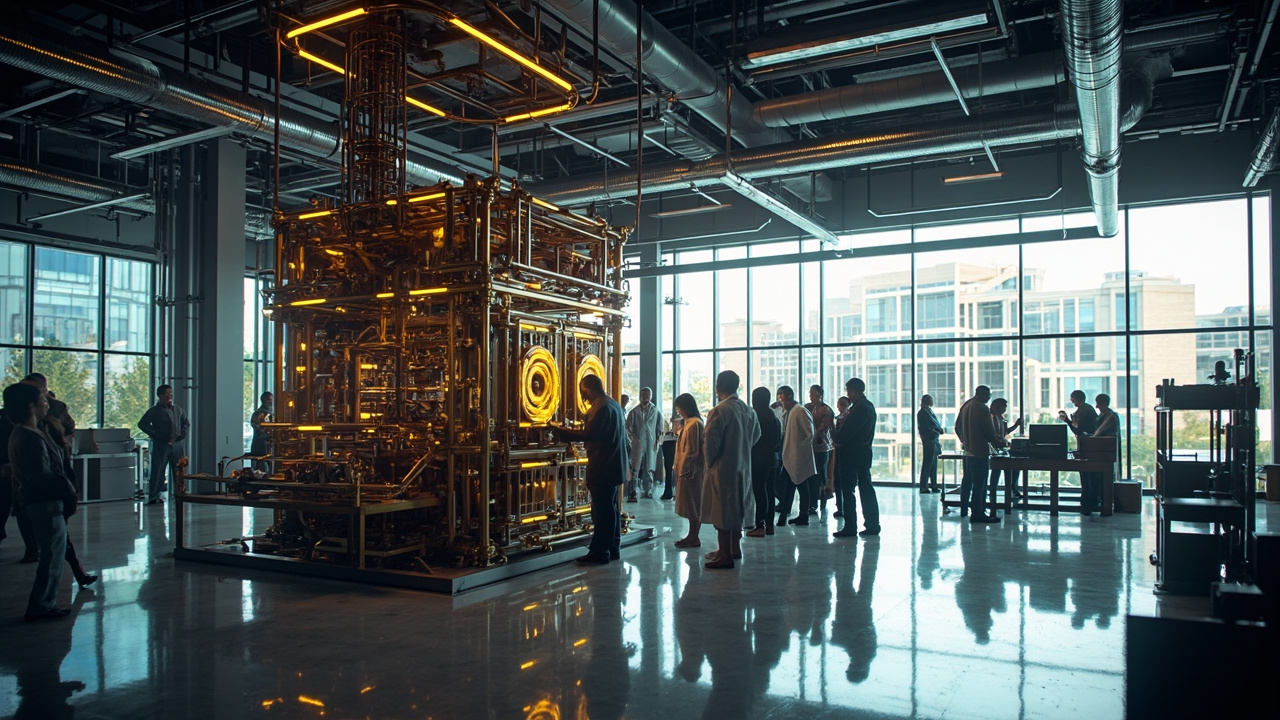
TL;DR: Microsoft opened a 15,000-square-foot quantum research center in the University of Maryland's Discovery District on Sept. 22, 2026, and will give DARPA direct on-site access to a Majorana 2 topological system for independent testing.
Microsoft handed government evaluators the keys to its newest quantum hardware. The company said Sept. 22, 2026, that it had opened a research center in Maryland alongside the University of Maryland and other industry partners, and that the facility will house a quantum system built around its Majorana 2 chip for independent testing and evaluation by the Defense Advanced Research Projects Agency, according to the Reuters report titled “Microsoft to give DARPA hands-on access to quantum system at new Maryland site.”
The announcement marks a change in how the Pentagon’s research agency examines Microsoft’s approach. Until now, DARPA teams assessed the company’s machines remotely through systems in Redmond, Washington, and Europe. The new arrangement places a system in a dedicated DARPA area in Maryland where agency specialists can install hardware and run their own boot sequences and checks.
For consumers and businesses, the work remains upstream from any product. Microsoft has said it plans to have commercial quantum systems ready by 2029, a future target, not a completed delivery. The Maryland system itself is described as a testing and evaluation installation, with room to grow toward larger prototypes over time.
New center places quantum hardware near Washington
The facility occupies 15,000 square feet in the University of Maryland’s Discovery District near Washington, D.C., according to the Reuters report and a separate account in The Quantum Insider titled “Microsoft Gives DARPA Access to Majorana System, Opens Maryland Quantum Research Center.”
That account describes the building as a mix of Microsoft proprietary research rooms, laboratories for partner companies, a DARPA testing zone and a hands-on training laboratory. Microsoft said in a company blog post by Dr. Charles Tahan, Partner, Microsoft Quantum, that the project was developed with the university, the state-backed Capital of Quantum Initiative and other industry participants.
The Maryland location builds on an arrangement first outlined a year earlier. With support from Maryland Gov. Wes Moore’s Capital of Quantum Initiative, the state acquired and renovated the Discovery Center, while Microsoft, the University of Maryland and the initiative designed the quantum facility inside it, according to The Quantum Insider.
The company said the center will support hardware research, partner integration, workforce training and government collaboration, and will reserve space for future prototypes and for outside firms seeking to connect machines or components to Microsoft’s software platform.
From remote logins to physical control
The central news for applied science is access. DARPA will have on-site use of Microsoft’s latest topological quantum system, including qubits built on the Majorana 2 chip, for evaluation under the agency’s Underexplored Systems for Utility-Scale Quantum Computing program, according to The Quantum Insider’s summary of Microsoft’s blog post.
That program forms part of DARPA’s broader Quantum Benchmarking Initiative, which seeks to determine whether competing quantum-computing methods can produce commercially useful machines by 2033. Microsoft said it is among the companies advanced to the final stage of the utility-scale program.
Other participants in the evaluation work include the Air Force Research Laboratory, the Johns Hopkins University Applied Physics Laboratory and national laboratories including Los Alamos, Oak Ridge, Lawrence Berkeley and Lawrence Livermore, according to The Quantum Insider.
Until the Maryland opening, agency review relied on remote connections. Corporate vice president of Microsoft Quantum Zulfi Alam told Reuters that the new setup lets DARPA specialists directly examine performance.
“This is a big deal for us because it essentially enables DARPA to kick the tires and to sort of figure out how good this machine is and how it's performing,” Alam said in an interview cited by Reuters.
Alam said the system in Maryland will begin with the Majorana 2 chip but was constructed so later chips under development can replace it. He also described DARPA as “a completely trusted organization” with which Microsoft can share present work and future plans, according to Reuters.
The shift matters because it gives outside testers authority over configuration, startup and measurement, rather than scheduled time on a distant machine. In an interview summarized by Constellation Research in “Microsoft opens its Maryland quantum research center,” Tahan said the Maryland site means DARPA researchers will not need to travel to Seattle or Copenhagen, making review more direct and continuous.
Tahan added that the delivered system is for testing and evaluation, not production, and could “potentially grow over time to larger prototypes,” according to Constellation Research.
How DARPA will judge the machine
DARPA’s central question is economic, not only scientific. Alam told Reuters the agency’s key evaluation metric is whether the value of computation performed by a quantum system outweighs the system’s cost.
He said that test imposes discipline as Microsoft moves from laboratory research toward a commercial product.
“It enforces a certain amount of engineering rigor that scientific teams normally do not have,” Alam said, according to Reuters.
Quantum computers are promoted for their potential to address problems that would require thousands of years on conventional machines. Of particular interest to national security specialists is protecting and cracking encrypted communications, Reuters reported.
Microsoft’s stated commercial goal is systems capable of handling useful workloads beyond the reach of conventional computers. That outcome has not been achieved in the industry. The Quantum Insider noted that the field has yet to demonstrate a broadly useful, fault-tolerant machine that can consistently outperform classical systems on commercially important work.
Microsoft has separately pointed to 2029 as its planned date for commercial quantum systems. That date is a company plan for the future and was reported as such by Reuters. Likewise, DARPA’s 2033 horizon is the agency’s target for learning whether any quantum approach can yield economically feasible systems, not a finding that such systems already exist.
Inside the topological-qubit bet
The hardware at issue uses topological qubits, a design intended to lower the burden of quantum error correction, according to The Quantum Insider. Quantum processors are highly sensitive to environmental noise and operational imperfections, so useful machines must detect and correct errors repeatedly during calculations.
Microsoft introduced Majorana 2 as its second-generation topological quantum chip. The company said the chip uses a new material stack that replaces aluminum with lead, a substitution described as improving performance.
The claims have drawn skepticism from some scientists. The Quantum Insider reported criticism from members of the scientific community who questioned the company’s assertions. Microsoft, in turn, characterized independent access as a necessary step in assessing whether its method can support an economically relevant quantum computer.
The future Maryland hardware path is modular. Alam said DARPA will start with Majorana 2, with the installation designed to accept future chips Microsoft is developing. Tahan similarly described potential expansion to larger prototypes, preserving the distinction between a present test system and planned successors.
Microsoft’s wider software approach does not rely solely on its own qubit design. The Quantum Insider said the company’s strategy supports multiple hardware types through a common software and infrastructure layer. Constellation Research quoted Tahan describing Microsoft as platform agnostic, adding “we just want the best computer,” while noting close partner Atom Computing operates a logical-qubit machine controlled by Microsoft’s Quantum OS platform.
Makerspace, partners and workforce training
A second element of the Maryland opening is education with physical equipment. A quantum hardware makerspace will give students, researchers, educators and people entering from other technical fields an opportunity to work directly with instruments, rather than learning only theory or software.
Initial makerspace partners named by Microsoft include AMD, Bluefors, Intel, IQM, Fermi National Accelerator Laboratory, Riverlane and Quantum Motion, according to The Quantum Insider and Constellation Research. Their contributions are expected to supply hardware access and technical expertise.
The company said participants will work through practical problems across the hardware stack, including selecting designs, deciding what to measure and diagnosing unexpected experimental results. That practical emphasis distinguishes the program from education efforts focused mainly on software simulation, according to The Quantum Insider.
Microsoft also plans annual measurement-based computing workshops and funding for quantum postdoctoral positions at the University of Maryland, The Quantum Insider reported. Constellation Research likewise reported that Microsoft will fund postdoctoral positions at the university.
A collaboration with Fermilab extends the training effort into control electronics. According to the Fermilab announcement titled “Fermilab and Microsoft partner to provide new quantum tools and expand quantum research,” the laboratory will expand the capabilities of its Quantum Instrumentation Control Kit, or QICK, an open-source hardware and software toolkit for controlling qubits and reading out information.
QICK was originally designed for superconducting qubits. Fermilab said its development team worked with partners to adapt it for trapped ions, cold atoms, silicon-spin qubits, quantum-dot and biological qubits.
“We are thrilled that Microsoft has chosen QICK to be part of the quantum hardware makerspace,” said Anna Grassellino, chief technology officer and associate laboratory director for the Technology Directorate at Fermilab, according to the laboratory announcement.
Tahan said the Fermilab work goes beyond instruction. “We are collaborating to broaden the applicability of quantum-control technologies across hardware platforms,” he said in the Fermilab announcement, adding that Microsoft is working with the University of Maryland to explore how tools such as QICK can be incorporated into education.
By sharing results with the open-source user community, Fermilab and Microsoft said they intend to supply new tools to the growing quantum ecosystem and help advance quantum information science. Fermilab’s development of QICK was originally supported primarily through its partnership in the Quantum Science Center, a Department of Energy National Quantum Initiative Science Research Center headquartered at Oak Ridge National Laboratory, according to the laboratory.
For now, the completed event is the opening and the access commitment. The commercial system planned for 2029, larger prototypes that could follow Majorana 2, and DARPA’s 2033 feasibility question all remain future matters to be tested in the new Maryland rooms.