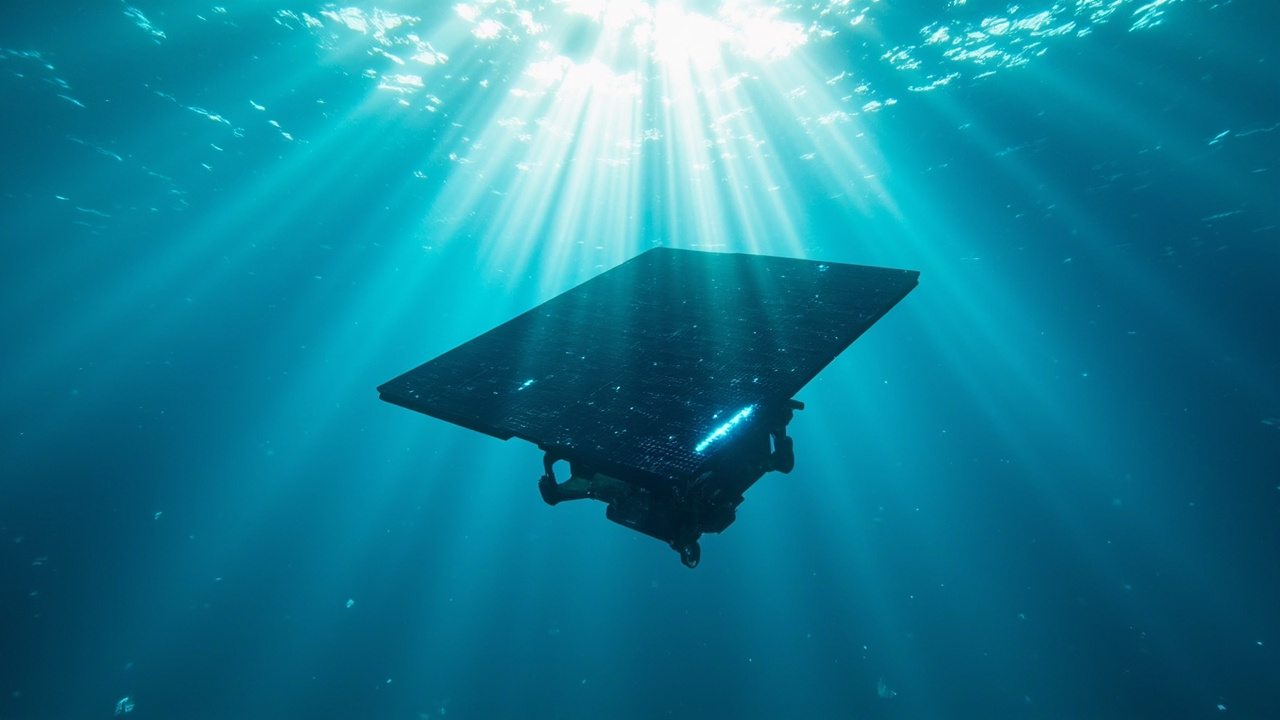
TL;DR: Researchers in China demonstrated wide-bandgap perovskite solar cells that generated 324 mWh in two hours at 10 meters depth in the South China Sea.
A solar cell built for blue-green underwater light
A research team led by Simin Ma at Yunnan University reported submerged perovskite solar cells designed to operate beneath the ocean surface, according to Ars Technica. The study, published September 11 in the Cell Press journal Joule, is titled “Submerged solar harvesting with wide-band-gap perovskites for autonomous underwater energy systems,” according to EurekAlert!.
The authors include Simin Ma, Bing Cai, Ruohao Wang, Jiayue Chen, Renzheng Liu, Lang Xu, Xiaodong Ren, Peng Gao, Michael Grätzel and Wen-Hua Zhang, with affiliations including Yunnan University in Kunming and Southwest United Graduate School, according to the Joule abstract. Wen-Hua Zhang of Yunnan University and Southwest United Graduate School is identified as an author of the work, according to EurekAlert! and pv magazine Global.
The central device is a wide-bandgap lead halide perovskite solar cell with a bandgap of approximately 1.96 electron volts, according to the Joule abstract and pv magazine Global. That bandgap was selected because its absorption is spectrally matched to the underwater solar spectrum at a depth of 10 meters, according to the Joule abstract. By depths of around 5 to 10 meters, available sunlight becomes predominantly blue-green light between roughly 400 and 600 nanometers, according to the research description summarized by ZME Science. Water strongly absorbs long-wavelength sunlight at or above 630 nanometers, which limits conventional terrestrial cells that absorb in the 800- to 1,150-nanometer range, according to the ScienceDirect preview of the Joule paper.
Why silicon struggles and perovskites fit
Conventional high-efficiency terrestrial solar cells are designed to absorb broader sunlight, including red and infrared wavelengths, according to the ScienceDirect preview. Underwater, those wavelengths fade rapidly, leaving dimmer blue-dominated illumination, according to ZME Science.
Perovskite materials offer high extinction coefficients and tunable bandgaps covering the submerged solar spectrum, making them candidates for weak short-wavelength light conversion, according to the ScienceDirect preview. Perovskites can be tuned to different wavelengths by adjusting chemistry during production, according to Ars Technica. Silicon solar panels are generally closer to 20 percent efficiency under standard sunlight, while the new submerged cells converted about 35 percent of filtered 10-meter light in laboratory testing, according to Ars Technica.
Moisture is particularly destructive to perovskites, which made them seem an unusual choice for underwater panels, according to Ars Technica. The researchers argued that lower light levels and cooler temperatures underwater should help the cells live longer, according to Ars Technica. The ScienceDirect preview states that perovskite cells suffer rapid degradation under intense light and temperatures at or above 65 degrees Celsius, while temperatures at or below 25 degrees Celsius and weakened underwater light favor durable operation.
The PHMG additive that stabilized the crystal
To make efficient and durable submerged cells, the team introduced polyhexamethylene guanidine hydrochloride, abbreviated PHMG, for energy-level modulation, according to the Joule abstract and pv magazine Global.
According to the Joule abstract, PHMG enabled the perovskites to convert from p-type to n-type, facilitating electron extraction, suppressing halide ion migration, reducing defect density and improving lattice stability. Ars Technica reported that the additive helped in several ways, including forming a water-repelling layer and interacting with the crystal lattice to help larger crystals form and prevent ions from moving around. The Joule summary states that the additive enhances crystallinity, optimizes energy-level alignment and suppresses interfacial non-radiative recombination, according to the Joule abstract.
The devices used an inverted p-i-n structure and PHMG as a crystallization additive, according to the Joule summary. The design principle involved guanidinium moieties integrated with a hydrophobic component, according to the ScienceDirect preview.
Laboratory efficiency under simulated 10-meter light
To evaluate performance under submerged spectra, the team designed an underwater solar simulator with customized optical filters, according to the Joule abstract. Zhang’s team developed a customized laboratory system with tailored optical filters to simulate underwater illumination at various depths, according to EurekAlert!.
Under that simulated 10-meter-deep illumination, the submerged perovskite devices delivered a power conversion efficiency of 34.71 percent, according to the Joule abstract and pv magazine Global. The Joule highlights list highest efficiencies of 17.08 percent under AM 1.5G standard sunlight and 34.71 percent under simulated 10-meter light, while the summary reports 16.79 percent as a certified AM 1.5G result, according to the Joule abstract. During laboratory experiments, the researchers determined that the submerged cells were among the most efficient wide-bandgap cells and could absorb blue-to-orange light, according to EurekAlert!.
Stability tests point to years of operation
Durability was a central claim. After building a panel by sandwiching the perovskite in protective layers, the team submerged it in seawater under filtered light for about 40 days, at which point it remained at 99.6 percent of its original efficiency, according to Ars Technica. Based on that test, the researchers estimated the panel should last 5.5 years in seawater before declining to 80 percent, the level typically considered the end of useful lifetime, according to Ars Technica.
Accelerated aging tests predict a T80 lifetime of 48,094 hours, or approximately 5.49 years, at 25 degrees Celsius under simulated submerged conditions at 10 meters depth, according to the Joule summary. The Joule highlights likewise list a predicted T80 of about 5.49 years under simulated 10-meter underwater illumination. The cells showed almost no degradation after 1,160 hours under simulated 10-meter conditions, according to EurekAlert! and pv magazine Global.
Separately, after storage for 300 days in a glovebox filled with nitrogen gas, the cells retained about 96 percent of initial efficiency, according to EurekAlert!.
Sea trial off the Weizhou Islands
The team then tested large-area perovskite solar modules in practical outdoor operation, according to the Joule abstract. Researchers integrated the perovskite cells with underwater robots and deployed them at 10 meters depth off the Weizhou Islands in the South China Sea, according to EurekAlert! and pv magazine Global. ZME Science identified the field location as waters off Weizhou Island.
The large-area modules generated 324 milliwatt-hours of electricity upon underwater illumination for two hours at 10 meters depth, according to the Joule summary and pv magazine Global. That output was sufficient to charge lithium-ion batteries and light LEDs, according to the Joule abstract and pv magazine Global. EurekAlert! reported that the cells generated 324 mWh when submerged for two hours, enough to charge lithium-ion batteries.
In the sea trial described by Ars Technica, the panel was attached to a small vehicle able to maintain depth and position and was used to charge coin-cell batteries for a couple of hours each at 2, 6 and 10 meters. Power fluctuated strongly at 2 meters because sunlight interacted with surface waves, while light became more consistent but dimmer at greater depth due to scattering, according to Ars Technica. At 10 meters, the panel produced a little less than one-quarter as much energy as at 2 meters, according to Ars Technica.
Zhang said the amount of electrical energy produced by the large-area modules during two hours at 10 meters was surprising, according to EurekAlert! and pv magazine Global. The researchers also said scaling from small-area laboratory cells to large-size modules had been achieved, according to EurekAlert!.
What this could power — and what comes next
The authors said the work paves the way for practical deployment of perovskite photovoltaics underwater and offers a route toward self-sustained marine energy systems and autonomous underwater devices, according to the Joule abstract. Potential uses include submerged sensors, cameras and communication systems far from land, according to EurekAlert!, as well as uncrewed underwater vehicles and sensors, according to Ars Technica. The paper concludes that the findings offer a promising route toward self-sustained marine energy systems and autonomous underwater devices, according to pv magazine Global.
The advance extends beyond earlier work focused on very shallow water. Wen-Hua Zhang said very few studies had been reported on underwater solar cells and that all had focused on depths of only two meters or less, according to EurekAlert! and pv magazine Global. Zhang described the new work as the first functional validation of submerged cells practically operating at about 10 meters, according to EurekAlert!.
For future research, Zhang’s team plans to test perovskite cells at deeper depths, investigate the limit at which underwater solar cells can operate, and work toward standardized testing protocols for underwater photovoltaics, according to EurekAlert!. The work was supported by the Yunling Scholar of Yunnan Province and the National Natural Science Foundation of China, according to EurekAlert!. The paper was assigned DOI 10.1016/j.joule.2026.102672, according to Ars Technica.
Why depth still sets the limit
Deeper water leaves progressively less usable light, even with a tuned bandgap. A 2020 analysis in Joule calculated that underwater photovoltaics could remain useful near 50 meters in exceptionally clear water if wider-bandgap materials were used, predicting an optimal bandgap near 2.1 electron volts at intermediate depths, according to ZME Science. In 2024, researchers reported organic solar cells for underwater use exceeding 25.6 percent efficiency at one meter, according to ZME Science.
The new result does not show operation at those greater depths. It demonstrates laboratory efficiency and a two-hour 10-meter sea deployment with battery charging, plus laboratory-based lifetime projections, according to the Joule abstract, EurekAlert!, pv magazine Global and Ars Technica.
Sources referenced
- A new solar cell could generate electricity underwater - Ars Technica (https://arstechnica.com/science/2026/09/a-new-solar-cell-could-generate-electricity-underwater/)
- Submerged solar harvesting with wide-band-gap perovskites for autonomous underwater energy systems: Joule (https://www.cell.com/joule/abstract/S2542-4351(26)00356-9)