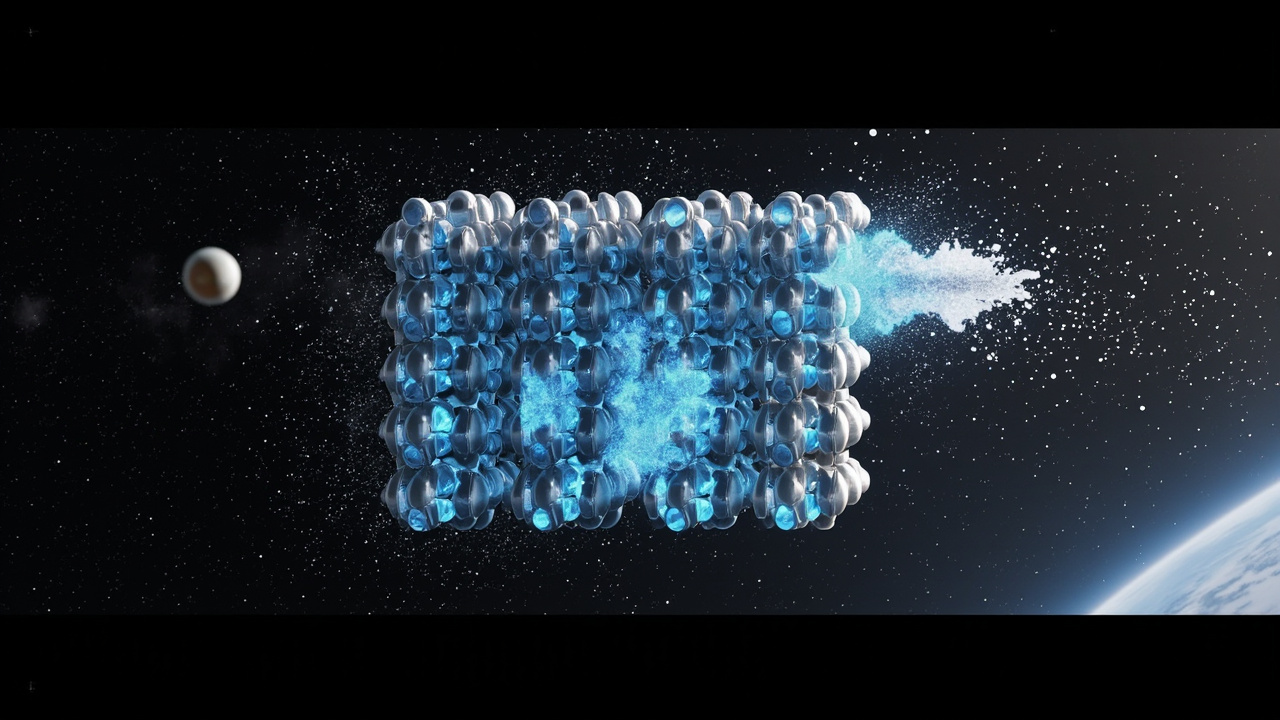
TL;DR: Chinese engineers found that water-filled aluminum eggshell arrays placed between plates cut an incoming projectile's speed by 64.9% in simulations at 7.5 km per second.
Eggshell arrays beat flat plates in impact test
Researchers from Dalian University of Technology in China designed a new spacecraft-wall material that copies the shape and mechanics of eggs, according to EurekAlert!. The work was published Sept. 8, 2026, in the Journal of Applied Physics by AIP Publishing as “Dynamics analysis on the water-filled aluminum eggshell array metastructure under hypervelocity impact.”
The authors are Yuxin Wang, Yuqing Liu and Hao Li, according to the publication record for DOI 10.1063/5.0324502. Their approach places ordered aluminum forms shaped like eggshells between two aluminum plates and fills the interior with water.
In simulations, three water-filled eggshell-array versions significantly improved protection against hypervelocity debris compared with a single-layer aluminum plate, according to the paper abstract. The best-performing version reduced projectile velocity by 64.9%, while a single-layer aluminum plate reduced velocity by 51%.
That comparison came from simulation analyses in which spherical projectiles struck the targets at 7.5 km per second, according to the abstract. Tests also included a water-filled aluminum spherical-array structure for comparison. The material-point method was used to model the dynamic behavior, perforation size, debris-cloud shape, residual velocity, kinetic energy and strain energy.
The best orientation points small end up
The three eggshell configurations differed only in orientation, according to the abstract. In one, the small ends of all eggshells contacted the faceplate. In a second, the blunt ends contacted the faceplate. In a third, the orientations alternated.
The version with all small ends contacting the faceplate offered the highest level of impact resistance among the target plates, according to the abstract. EurekAlert! described the same result as eggs placed upright with the small end contacting the top plate, arranged blunt side down between two aluminum impact plates.
That finding echoes the familiar demonstration of walking across cartons of eggs without breaking them, according to Ars Technica. The trick is to align eggs with the narrow tip pointing up and spread weight across the full surface so no single egg is overloaded.
Ars Technica reported that cracking an egg takes around 5.5 pounds of force, depending on direction and distribution across the shell surface. The new shielding study applies that distribution principle at the scale of spacecraft walls, where many linked shells share the load.
Water filling suppresses shock waves
Water inside the aluminum eggs is not passive filler. Under high impact, the water moves and limits propagation of impact waves, according to EurekAlert!. Interaction between water and the aluminum shell then reduces and dissipates impact energy.
The result is sequential collapse rather than sudden failure in one spot. Energy gradually dissipates through the material as each shell collapses and deforms in turn, according to EurekAlert!.
Author Yuxin Wang said natural structures offer a useful model because “Natural biological structures have evolved to demonstrate excellent energy absorption performance over long-term adaptation,” according to EurekAlert!.
Wang added that “A single eggshell breaks easily under local force, but the protection mechanism of the eggshell array is completely different,” according to EurekAlert! and Popular Science. The team attributed the gain to cooperative behavior across units.
“The cooperative deformation of these eggshell units transforms the local impact load into distributed energy dissipation across the metastructure,” Wang said, according to EurekAlert!. That distributed response was linked to stronger anti-impact performance for the protected plates.
How it upgrades the Whipple shield
Spacecraft are commonly protected by a Whipple shield, which uses a thin outer bumper separated by empty space from the spacecraft wall, according to Ars Technica. The bumper is intended to break incoming particles and spread impact energy over a larger area of the wall.
The concept has produced many variants over the decades, including shields with multiple bumpers and shields with filling between rigid layers, sometimes called stuffed Whipple shields, according to Ars Technica.
The eggshell array is a biomimetic filling for that gap. The ordered aluminum eggshell arrays were designed with internal water filling, based on the biomechanical and mechanical properties of eggs, according to the paper abstract. The structures were made with three-dimensional printing technology.
Popular Science described the prototypes as aluminum eggshell-shaped designs arrayed together, with each egg filled with water. The publication said the linked forms deform cooperatively, spreading energy across a larger structure and making the surface a candidate for reinforced shielding.
The sandwiched, water-filled eggshell material performed best among the compared prints and simulations, according to EurekAlert!. The alternatives were aluminum plates alone, water-filled aluminum spheres sandwiched between plates, and the eggshell structures.
Why orbital debris demands new armor
The danger is not theoretical. In 2007, a piece of debris punched a bullet-like hole through the radiator panel of the U.S. space shuttle Endeavour, according to Ars Technica. The shuttle program ended in 2011, but launches of satellite constellations, telescopes and spacecraft have intensified the debris problem.
Ars Technica illustrated the Endeavour damage from mission STS-118, with an entry hole about 5.5 mm and an exit hole twice as large. The images were credited to NASA.
A NASA report from 2021 estimated about 34,000 pieces of debris larger than 10 centimeters in near-Earth orbit, about 900,000 pieces between 1 cm and 10 cm, and roughly 128 million pieces smaller than 1 cm, according to Ars Technica. Even the smallest particles can damage spacecraft because of high velocities.
EurekAlert! summarized the threat as nearly 1 million pieces larger than 1 centimeter in near-Earth orbit. Popular Science used a similar figure of around one million pieces larger than one centimeter.
Popular Science reported that each fragment travels at roughly 17,400 miles per hour. At that speed, tiny trash becomes dangerous to missions, crews and hardware, which is why agencies monitor existing debris while researchers test cleanup and protection methods.
What eggs teach engineers
Eggshells have long interested scientists because of their mechanical behavior, according to Ars Technica. Cracking an egg cleanly requires applying just enough force to the center without completely shattering the shell.
In 2012, MIT mechanical engineer Pedro Reis co-authored work linking an egg’s ovoid geometry to rigidity, an important factor in predicting how much force an object can endure before cracking, according to Ars Technica. Rigidity is related to strength but distinct: a cracked shell and an intact shell can share rigidity while differing in strength.
The aerospace industry used eggshell resistance to shattering as a model during failure-analysis studies of metal airplane shells in the 1950s and 1960s, according to Ars Technica. That crack resistance reflects structure similar to tooth enamel or seashells.
An eggshell consists mostly of calcium carbonate crystals embedded in a protein matrix, reinforced by a thin collagen inner membrane, according to Ars Technica. The combination has been described as nature’s perfect packaging.
Reis began studying eggshells after taking part in a physics demonstration involving walking on cartons of eggs without breaking them, according to Ars Technica. The classic student egg-drop challenge explores the same issue from another angle: finding the best way to keep a single egg from breaking after a fall from height.
The long-standing assumption was that vertical placement is best, consistent with Reis’s 2012 work, according to Ars Technica. Earlier in 2026, MIT colleague Tal Cohen tested that assumption and found that horizontal eggs can absorb more energy and compress more under the same force when energy absorption matters.
Cohen’s department leads MIT’s annual egg-drop challenge, according to Ars Technica. Follow-up experiments found horizontally positioned eggs cracked less frequently than vertical eggs dropped from the same height.
What must happen before flight
The laboratory result is not yet flight hardware. Before use as lightweight shielding on spacecraft, the material’s geometry and filling need further optimization and impact testing, according to EurekAlert!.
The researchers are refining aluminum-shell thickness, aspect ratio and layout to improve protective energy absorption, according to EurekAlert!. Those variables control weight, strength and how the array collapses under strike.
Wang said the effort points toward biology-inspired design for extreme impacts. “This work demonstrates that bionic, lightweight metastructures are a promising route for hypervelocity-impact protection,” Wang said, according to EurekAlert!.
The team hopes the research draws more attention to bio-inspired protective structures, according to EurekAlert!. The article record lists the Journal of Applied Physics paper as appearing Sept. 8, 2026, with access through DOI 10.1063/5.0324502.
For spacecraft designers, the near-term message is comparative: ordered, water-filled eggshell arrays outperformed flat aluminum and spherical-array alternatives in the modeled 7.5 km-per-second strikes, according to the abstract. The largest gain came when every small end faced the outer plate, turning a local hit into a shared structural response.
Sources referenced
- The secret to protecting next-gen spacecraft might be eggshells - Ars Technica (https://arstechnica.com/science/2026/09/how-eggshells-can-protect-spacecraft-from-space-debris/)