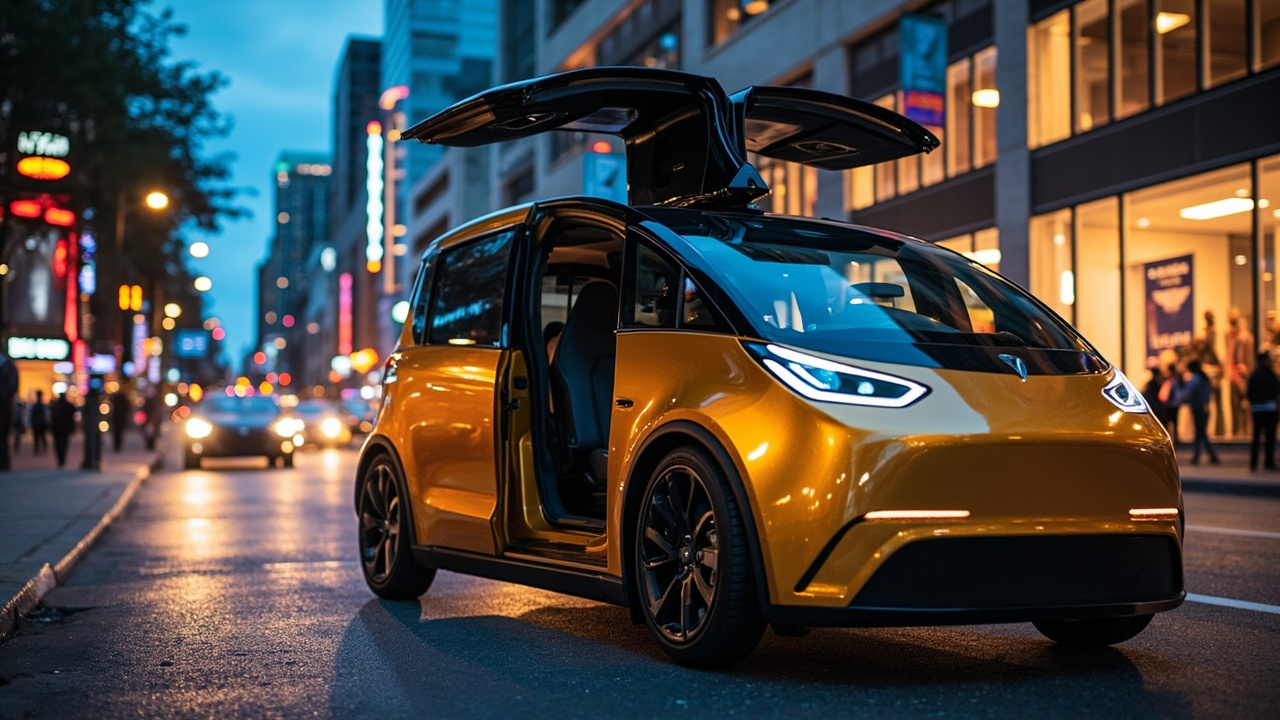
TL;DR: Tesla started public Cybercab rides in Austin, Texas, on Sept. 3, 2026, using a two-seat car with no steering wheel or pedals.
Tesla opened its steering-wheel-free taxi to the public in Austin on Thursday, Sept. 3, 2026, according to AP News reporting on Tesla launches steering-wheel-free Cybercabs on Austin, Texas, streets. The company said rides were available in limited areas of Austin in its two-seater Cybercab, a vehicle without a steering wheel or pedals, according to Reuters reporting on Tesla starts Cybercab rides in Austin, drawing US safety agency interest. The launch placed dozens of the purpose-built cars onto city streets through Tesla's Robotaxi app.
What launched in Austin
The vehicle that entered service is a two-door, two-seat coupe with gull-wing doors and a gold-colored exterior shown in downtown Austin on Sept. 3, 2026. Inside, it has bench-style seating for up to two passengers and a large central touchscreen, with trunk space described as room for luggage, scooters and other large items. There is no steering wheel, no brake pedal and no manual driving position.
Tesla positions the car as fully autonomous, designed to operate with no driver controlling the vehicle and using its Full Self-Driving technology. The company has described the cabin as lounge-like, with plans for entertainment features including music, gaming and video.
Rides are requested through the Robotaxi app on iOS and Android, functioning much like other ride-hail requests. Tesla wrote on its website, "Hail your car and use it for errands, commuting and more."
How the first day worked
Tesla marked the debut with an invite-only event in downtown Austin on Thursday night, followed by wider availability. An executive announcement at the event confirmed the Cybercab had been added to the public robotaxi fleet, which until then had consisted only of Tesla Model Ys.
According to event reporting, Ashok Elluswamy, Tesla's vice president of AI, told attendees:
"You can go outside, take rides."
He added that anyone could take rides and that service was open to the entire public.
Tesla confirmed the Cybercab would join its Robotaxi fleet Friday at 5 p.m. CT. Hundreds of fans were welcomed to downtown Austin for initial rides in the driverless cars, according to WIRED reporting in Tesla’s Cybercab Officially Launches Today. It’s Already Under Investigation.
Where riders can request one
At launch, the Cybercab option appeared to be initially available only in Austin, even though Tesla's Robotaxi app lists autonomous ride-hailing in Austin, Dallas, Houston, Miami, Orlando and Tampa, according to Engadget reporting on Tesla Starts Offering Cybercab Robotaxi Rides.
Even in Austin, riders could not specifically select a Cybercab, at least for now. What a customer receives depends on group size and availability. Only two people can fit on the bench seat, so larger parties would not be matched to the vehicle.
The broader Robotaxi network was described as operating in a handful of cities in Texas and Florida. Tesla had already been expanding its driverless Robotaxi service using Model Y vehicles in Houston and Dallas before the Cybercab joined the fleet.
How many Cybercabs are on Texas roads
Texas records cited at launch showed Tesla had 45 Cybercab vehicles among about 420 autonomous vehicles registered in the state. Another account of the state authorization said Tesla was authorized to operate 314 vehicles without a driver in Texas, with most of them Model Ys and only 45 units being Cybercabs.
It was not clear how many of those 45 cars were operating as taxis picking up passengers and how many were part of testing efforts. All Cybercabs operating in Austin were owned by Tesla itself.
That limited starting fleet contrasts with Tesla's manufacturing ambitions. The company has manufacturing capacity planned for as many as 125,000 Cybercabs annually, with CEO Elon Musk ultimately envisioning production at a much larger scale. WIRED reported the company intends to deploy millions annually over time.
Who owns the cars — and who might next
The Austin launch fleet is Tesla-owned. The vehicles are still not available for sale to consumers.
When Tesla unveiled the model nearly two years earlier, Musk said he envisioned owners holding several Cybercabs and managing a fleet that could earn money through a ridesharing network. At launch, Tesla was taking inquiries from parties interested in helping build its robotaxi network, indicating it would initially sell to companies that can purchase whole fleets.
Tesla also began exploring potential commercial fleet orders, asking companies and entrepreneurs to express interest in purchasing fleets or building infrastructure to support the Robotaxi network.
Why Tesla is betting on no controls
Musk sent dozens of self-driving Cybercabs without steering wheels or brake pedals onto Austin streets on Thursday, betting Americans will overcome fears about surrendering control, AP News reported.
Investors view autonomy as key as Chinese rivals intensify pressure on Tesla's electric-vehicle business, Reuters reported. Musk has said Tesla should no longer be regarded as an automaker, but as a robotics and autonomous vehicle company.
The Cybercab embodies that shift. Unlike a Model Y adapted for driverless operation, it was designed from the start with complete autonomy in mind, with absolutely no driver controlling the vehicle.
Federal safety review began immediately
The debut drew immediate federal attention. The National Highway Traffic Safety Administration opened an Audit Query examining the data and process Tesla used to determine the Cybercab complies with existing safety standards.
Tesla has said it does not need an exemption because its vehicles comply with all existing safety standards. Federal rules cap sales of vehicles without steering wheels and pedals, and unusually shaped robotaxi developers have generally been told to apply for an exemption before picking up passengers.
Amazon subsidiary Zoox, whose vehicles do not have steering wheels or manual controls, won the first of these exemptions this summer, which limits its operations to 2,500 vehicles this year.
NHTSA is currently updating vehicle standards to make it easier and faster for driverless cars to deploy. It is tweaking eight rules, including those requiring parts that driverless cars do not use in the same way, such as brake pedals, windshield wipers and rearview mirrors. For now, years-old standards remain in place.
In a statement, NHTSA Administrator Jonathan Morrison said his agency "fully supports the safe development and deployment of automated vehicles."
He added:
"But as the federal regulator, we need to ensure that all of our laws are followed."
What an Audit Query can do
The Audit Query will examine whether the Cybercab meets federal safety standards despite lacking manual controls. Ann Carlson, a former acting NHTSA administrator who is now a professor of environmental law at UCLA, said the investigation was likely an indication that the agency is frustrated with Tesla after making clear through the Zoox case that it expects developers to use the exemption process.
This kind of federal investigation can prove consequential. NHTSA can require an automaker to change its vehicle or process and can pursue enforcement actions, including civil penalties. Volvo Group North America paid $130 million in penalties in 2023 after an investigation into its recall process and agreed to three years of oversight by a third-party auditor.
Tesla did not immediately respond to a request for comment on the investigation.
What riders should expect next
For now, the Austin launch represents one of Tesla's biggest real-world tests of fully autonomous transportation. Customers can request a ride through the Robotaxi app in the same way they would request Uber, Lyft or Waymo, but availability of the Cybercab itself remains limited.
Tesla has not announced a specific timeline for bringing the steering-wheel-free Cybercab to Houston, Dallas or the Florida cities where Model Y robotaxis operate. The company confirmed only that the Cybercab option was initially appearing in Austin and that assignments depend on party size and vehicle availability.
The combination of a 45-vehicle starting fleet, a planned annual capacity of 125,000, and a federal compliance review means the near-term story is small-scale operation paired with large-scale ambition.