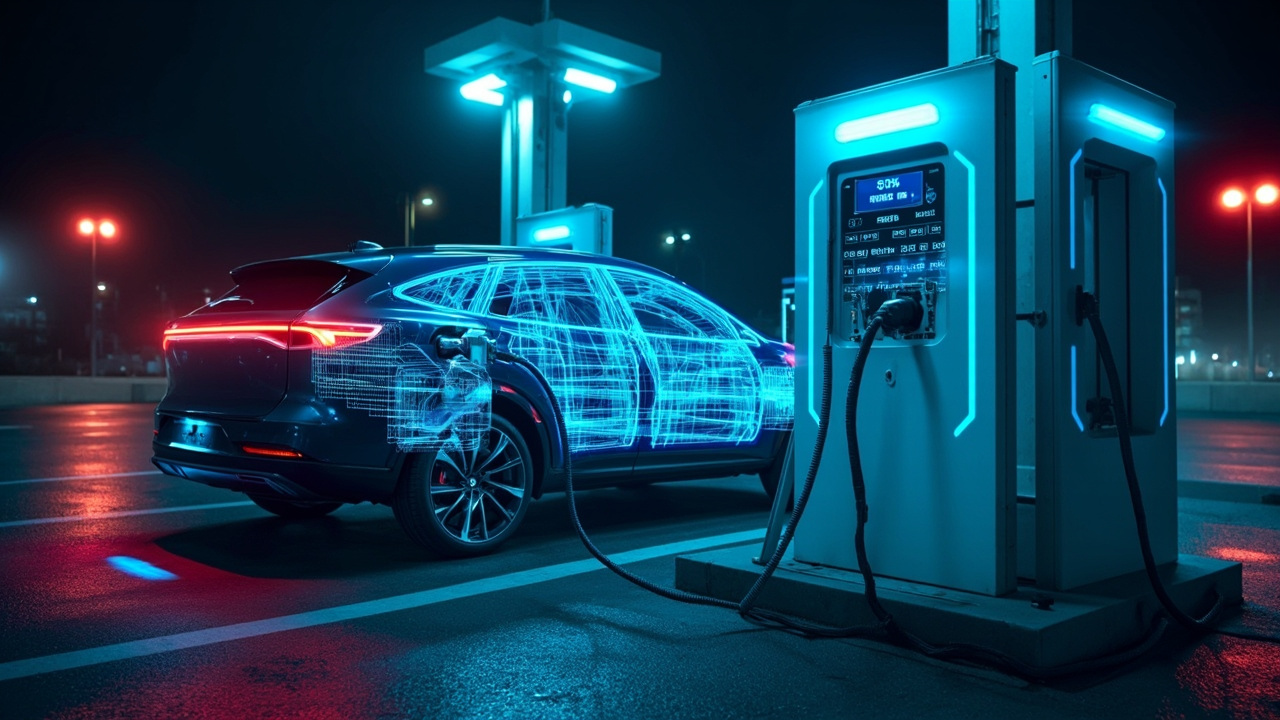
China Breaks the 5-Minute EV Charge
TL;DR: Geely unveiled Sept. 23 a system that charges an EV battery from 10% to 70% in 4.5 minutes, joining BYD and CATL in pushing China past 5-minute ultrafast charging.
Chinese electric-vehicle charging passed a threshold long treated as the gasoline benchmark. According to the Associated Press in "Chinese auto companies race ahead on EV technology, achieving 5-minute ultrafast charging", Geely Auto on Sept. 23 unveiled technology that charges a battery from 10% to 70% in 4.5 minutes. The same system reaches 10% to 97% in 8 minutes and 40 seconds.
That announcement places Geely alongside BYD and CATL, which the Associated Press said both rolled out around 5-minute ultrafast charging this year. BYD last year overtook Tesla as the world's biggest EV maker, while CATL is the world's largest EV battery maker. The Sept. 23 Geely launch was reported from Ningbo, China, according to Reuters in "Geely Turns to 4-Minute EV Charging, AI in Battle With BYD".
What Geely announced on Sept. 23
Geely said its new setup can move a vehicle battery from 10% to 70% in 4.5 minutes and from 10% to 97% in 8 minutes and 40 seconds under normal ambient temperatures, according to Reuters. The company linked the result to a 2.2-megawatt charging infrastructure and a high-rate battery capacity.
A separate Reuters explainer published by The Hindu BusinessLine described peak output of up to 2.25 megawatts from a single charging gun and the same 4.5-minute and 8-minute-40-second times at room temperature. That account also said Geely introduced a next-generation electric-vehicle battery alongside the charging system.
Geely also introduced an upgraded Galaxy E5 pure-electric SUV at the same event, according to Reuters. The company presented the vehicle and battery as part of an effort to revive sales in China, where EV sales declined for 11 consecutive months through August.
Where BYD and CATL stand
BYD in March launched a new generation of its "blade" EV battery that it said can charge an EV from 10% to 70% in 5 minutes and from 10% to 97% in 9 minutes, according to the Associated Press. Reuters separately described BYD's new-generation flash-charging system as able to charge a battery from 10% to 97% in nine minutes.
CATL in April rolled out technology that can charge an EV from 10% to 80% in 3 minutes and 44 seconds and from 10% to 98% in 6 minutes and 27 seconds, according to the Associated Press. Li Auto's flagship electric vehicles are equipped with CATL's 5C Kirin battery, which can add up to 500 km (310 miles) of range in 12 minutes, according to Reuters.
Battery maker Sunwoda joined the flash-charging race earlier in September with a battery system promising 10%-97% in 9 minutes, according to Reuters. Rival BYD has developed megawatt-level flash-charging systems and blade batteries capable of charging from 10% to 97% in 9 minutes.
How China compares with U.S. charging times
By comparison, some of the fastest-charging EVs available in the U.S. can take roughly 20 minutes, analysts told the Associated Press. In the U.S., fast-charging sessions typically take roughly 20 to 40 minutes to charge from 10% to 80%, according to S&P, although newer models from Hyundai, Kia and Porsche can reduce charging times to approximately 18 to 20 minutes under optimal conditions.
A standard 10% to 80% charge on a Tesla Supercharger usually requires 15 to 25 minutes, roughly double the time claimed by the latest Chinese systems, according to Reuters. Mercedes-Benz offers fast charging from 10% to 80% in as quickly as 22 minutes.
"China is way, way, way ahead in terms of multiple players engaged in the charging competition," said Lei Xing, an independent analyst of China's auto industry based in Massachusetts, according to the Associated Press. Neal Ganguli, a partner and managing director in the automotive and industrial practice at consultancy AlixPartners, said the U.S. charging network is growing rapidly but remains well behind China's ultrafast speeds by orders of magnitude.
Why automakers are chasing gasoline-like refueling
Chinese automakers are seeking to eliminate range anxiety by narrowing the gap between EV charging and the roughly five-minute refueling experience of gasoline vehicles, explained Stephen Chan, an analyst at S&P Global Ratings, according to the Associated Press. Chan described range anxiety as the "ultimate barrier" to EV adoption.
China's EV market has moved into a battle over technology, with automakers competing on intelligent driving systems, range and ultra-fast charging capabilities to attract buyers, according to Reuters. With more than 100 domestic passenger car brands, Chinese automakers face intense competition, according to the Associated Press.
Domestic car sales have fallen for months in China as automakers are exporting more cars overseas, according to the Associated Press. A focus on technological advances like ultrafast charging is a way to set themselves apart and try to improve sales. Reuters similarly said manufacturers are seeking to ease consumer range anxiety and rekindle demand in the world's biggest car market, where growth has slowed.
Heat, degradation and the engineering response
Despite the breakthroughs, experts cautioned there are other obstacles, according to the Associated Press. "The real challenge is whether the battery can accept that level of current quickly and repeatedly without overheating, excessive degradation or internal bottlenecks," said Chris Liu, a Shanghai-based senior analyst at Omdia, a technology research and advisory group.
Pushing megawatt-level currents into lithium-ion batteries poses engineering challenges involving heat, battery wear and power grids, according to Reuters. The same report highlighted risks including fire, battery degradation and potential strain on power grids.
To prevent hotspots, Geely introduced a full-loop "five-end" liquid cooling network that circulates fluid through the station's storage batteries, liquid-cooled cables and vehicle charging ports, according to Reuters. Automakers are making certain EV battery cells shorter or adopting "short-blade" designs with less friction to keep batteries from overheating during fast charging.
Software is also part of the response. Geely is deploying an AI system with deep-learning algorithms running directly on the vehicle so it can anticipate temperature rises 30 seconds in advance, according to Reuters. Reuters separately reported that Geely uses cloud-based twin simulations paired with deep-learning models deployed on the EV to monitor battery health, manage thermal control and predict potential hazards.
To combat battery wear from fast charging, automakers and battery makers use methods such as specialized coatings or high-frequency pulse currents, according to Reuters. Geely is deploying AI across cloud and on-vehicle systems to support stability and safety under high power.
Charging networks and grid limits
Success will depend on factors including the scale of companies' charging networks, according to the Associated Press. The majority of China's public charging stations still operate below 1 megawatt, while Geely, BYD and CATL's ultrafast technologies rely on higher charging power to reach full potential, said Chan at S&P. Network expansion or grid updates will remain hurdles for large-scale adoption.
BYD is targeting 20,000 superfast charging stations by the end of this year, followed by 30,000 more in 2027 and 40,000 in 2028, bringing the total to 90,000 stations by that time, according to a Deutsche Bank analysis cited by the Associated Press. Reuters separately reported that BYD plans to build 90,000 flash-charging stations by 2028 and install 300 of those over the next year in the UK.
To prevent power grids from collapsing under multi-megawatt charging demands, fast-charging stations are integrated with battery storage systems and solar power, according to Reuters. Smaller rival NIO has over 4,000 battery-swap stations where a full battery replacement takes about three minutes.
What companies say comes next
Geely executive Zhang Dewang told Reuters at the launch event that charging speeds are approaching a physical limit. "Current charging speeds are already approaching the physical limit, and the marginal gains from pursuing even faster speeds in the future will become increasingly small," Zhang said.
A Geely executive told Reuters that charging speeds are hitting a ceiling and hinted at moving from speed competition to large infrastructure installations to accelerate rollout of fast-charging networks. Geely's Zhang said the broader charging ecosystem would in the future resemble traditional gasoline stations with diverse brands, adding that multi-party infrastructure development will accelerate global rollout of fast-charging networks.
Ganguli believes the U.S. may not attempt to match China's "megawatt race" in the near future but pursue a "more moderate" path to upgrades, according to the Associated Press. That outlook frames the near-term split: China pushing megawatt charging and station construction, while U.S. upgrades proceed at lower power levels.