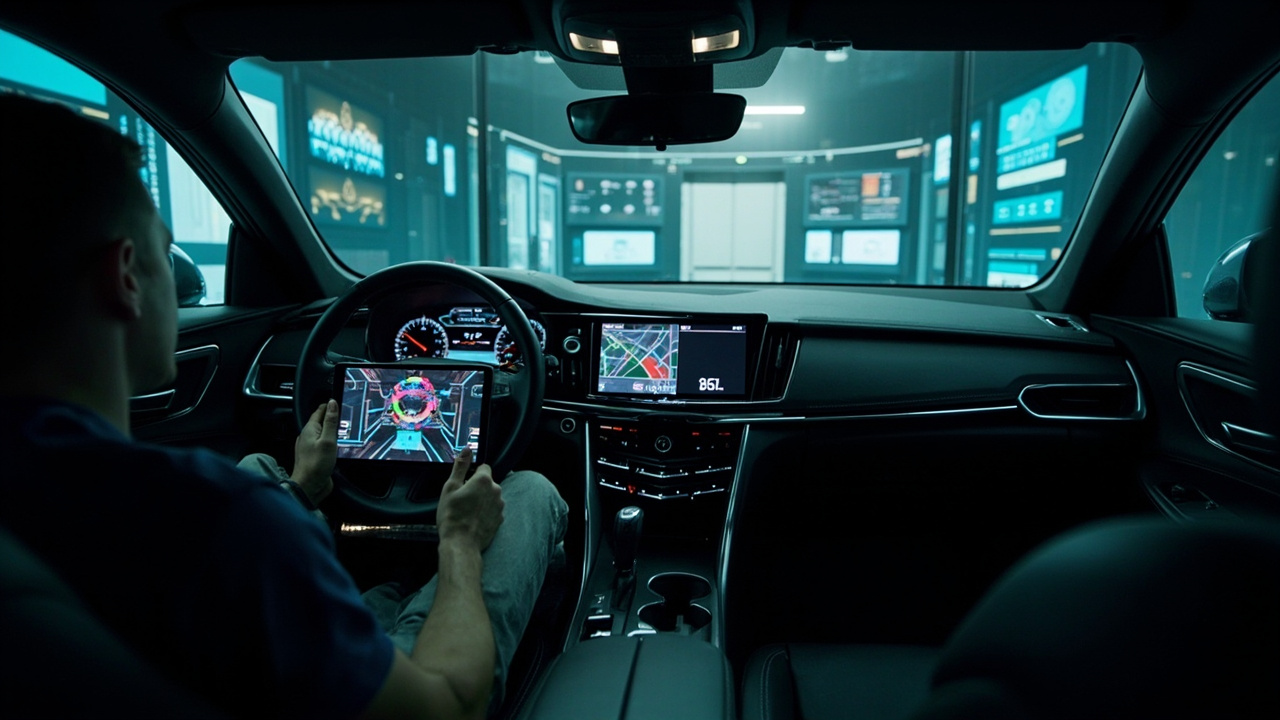
TL;DR: General Motors plans to launch eyes-off Super Cruise on the 2028 Cadillac Escalade IQ and is using immersive simulators at Warren, Michigan, to study how distracted drivers hand control back.
GM sets 2028 target for eyes-off driving
General Motors says its next generation of Super Cruise will allow drivers to look away from the road, with introduction planned for 2028 on the Cadillac Escalade IQ luxury electric sport utility vehicle, according to the Associated Press report published as “From ‘hands-free’ to ‘eyes-off’: How General Motors is simulating its way to autonomous driving.”
The plan positions the Escalade IQ as the first retail application of GM’s eyes-off capability. The Dallas Express summarized the same timeline in its article “GM Uses Candy Crush In Simulators To Test Eyes-Off Driving For 2028 Escalade IQ,” noting that initial use is expected to begin on highways.
GM previously announced that 2028 target on Oct. 22, 2025, and said availability and permitted use would differ by state, according to the Dallas Express account. The ability to look away therefore remains a future product goal, not a feature available to buyers today.
Industry analysts see 2028 as a shared horizon. Sam Abuelsamid, vice president of market research at Telemetry, told the Associated Press that 2028 is the broad period when a group of companies aims to field systems that operate at highway speeds on a wider set of roads than current systems cover.
Abuelsamid also described the commercial logic. He said going eyes-off is the turning point where shoppers become more willing to pay, because drivers regain time when they no longer must watch traffic continuously. Automakers view that time savings as the basis for subscriptions to automated-driving capability.
What changes from today’s Super Cruise
Super Cruise in showrooms today is a hands-free assisted-driving system, explicitly not self-driving, according to the Associated Press. GM has offered it since 2017.
The current system lets a driver remove hands from the wheel while keeping eyes on the road on compatible routes. GM describes the benefit as reduced stress during routine commuting on approved roads, in comments from Tyson Becker, executive director for autonomous vehicle strategy and product, cited by the Associated Press.
Coverage now exceeds 630,000 roads in the United States and Canada, with additional roads in other countries, according to the Associated Press. More than 20 models across Cadillac, GMC, Buick and Chevrolet carry the technology. GM intends to add Super Cruise to more models in coming years.
Today’s operation still demands attention. The Dallas Express, citing GM’s August 18 update, reported that current Super Cruise can manage steering, acceleration and braking on compatible roads under defined conditions, but drivers must watch the road and must not use a hand-held device.
Becker said the next generation is intended to be safe enough that occupants could use a phone, open a laptop, join a meeting or watch a movie while the system is active, according to the Associated Press. That definition separates eyes-off travel from hands-free assistance.
Inside the Warren simulator
Development work centers on the Global Technical Center in Warren, Michigan, in suburban Detroit. There, hundreds of volunteer drivers climb into a real Cadillac Lyriq or other familiar GM vehicles, according to the Associated Press.
The cabin is genuine, but the roadway is synthetic. The vehicles sit inside a 360-degree immersive environment that generates hills, construction zones, rain, surrounding traffic and ordinary cruising, according to the Associated Press.
Researchers in a nearby control room track physiological and behavioral signals. Measurements include eye movement, gaze duration, attention patterns, heart rate, stress and perspiration, according to the Associated Press. The Dallas Express similarly reported that researchers monitor eye movements, heart rate and other responses to learn how people use automated features.
GM characterizes the exercise as testing people as much as machines. The simulator evaluates how a driver understands the system, whether prompts feel intuitive, how comfortable and convenient operation feels, whether drivers trust the system, and how many seconds a person needs to resume full control of a moving vehicle, according to the Associated Press.
After each session, participants describe how they felt and how they interpreted system behavior, according to the Associated Press. Engineers then compare those impressions with sensor records.
Why Candy Crush helps measure attention
One assessment tool is deliberately ordinary: Candy Crush.
Volunteers play the mobile puzzle game on a tablet mounted in the test vehicle during simulated eyes-off operation, according to the Associated Press. A Sept. 18, 2026 demonstration at Warren showed senior researcher Akilesh Rajavenkatanarayanan playing the game in a Lyriq while the simulator ran.
The game is useful because players try to beat their high score, which creates genuine engagement, Maureen August, senior manager at GM Research and Development, told the Associated Press. Researchers can then interrupt that focus and measure how quickly and effectively attention returns to driving.
“We found it’s very effective for getting people involved and wanting to get the highest score,” August said, describing the method as a way to engage a participant and then pull that person away from the task.
The Dallas Express reported the same purpose, writing that researchers examine how fast drivers redirect attention when the system asks them to take control, citing AP reporting.
August said the goal is to confirm that alerts arrive early enough for an effective handover when needed, while also confirming that occupants can remain relaxed when the vehicle remains capable, according to the Associated Press.
Teaching cars the unexpected
A central engineering problem is the long list of rare roadway events. The Associated Press listed examples studied by GM: an animal or child entering the street, a detour missing from navigation, or a newly active work zone.
The vehicle system must recognize that conditions changed and respond safely. GM combines data collection, artificial intelligence and simulation to address that challenge, according to the Associated Press.
In the simulator, drivers with varied experience encounter computer-generated highway and city scenes populated with other simulated people, vehicles and signs, according to the Associated Press. August said the intent is to capture anything customers might meet on public streets.
Real-world miles provide another input. General Motors’ careers feature “Building Trust in Eyes-Off Driving at GM” says product and engineering teams validate performance against three streams: telemetry from production retail vehicles now in customer hands, high-precision capture from a next-generation development fleet, and high-fidelity synthetic environments built for rare edge cases.
That same company feature says retail-vehicle data is gathered with safeguards intended to protect privacy and is selected to focus on operating areas expected to deliver the greatest customer value.
Virtual testing is particularly important for dangerous or uncommon events that engineers cannot readily stage on public roads, according to the Dallas Express summary of GM’s May 27 development account. The proposed sensing set combines lidar, radar and cameras with driving data and simulation, according to the same summary.
Trust and competition shape the rollout
GM is folding lessons from two programs into the retail product. The company feature “Building Trust in Eyes-Off Driving at GM” says eyes-off development brings together the production scale of Super Cruise, with experience across millions of customer miles, and the artificial-intelligence and testing expertise developed at Cruise.
John Kaychi, senior group product manager for automated driving, leads the product team focused on customer experience for eyes-off driving, according to that GM feature. Kaychi said superior engineering alone is insufficient without confidence.
“But if customers don’t trust it, it won’t stick,” Kaychi said.
Kaychi described three industry waves — ridesharing, robotaxis and retail — and argued that retail will test autonomy at scale and offer the largest customer benefit, according to the GM feature. A domain-by-domain rollout, validating each capability against real conditions before expanding, is central to that approach.
Rival systems remain hands-on in terms of attention. Ford’s BlueCruise also permits hands-free operation but requires sustained attention and readiness to intervene, according to the Dallas Express. A camera tracks eye gaze and head position and triggers escalating warnings when attention drifts, according to the same report.
For now, GM tells Super Cruise users to keep watching traffic. The eyes-off Escalade IQ system planned for 2028 would change that division of labor, but only within the domains and states where GM validates it.