TL;DR: Tooth chemistry puts T. rex at 36.3°C, matching elephants and people
A team led by UCLA geochemists Randon J. Flores and Robert A. Eagle measured body heat directly from fossil tooth enamel and calculated an average of 36.3 degrees Celsius, plus or minus 2.5 degrees, for Tyrannosaurus rex. That result, reported Sept. 16 in the journal Science Advances, places the predator near modern humans and elephants and well above the water and air temperatures of its Montana floodplain home, according to Ars Technica and UCLA.
The work does not by itself prove every detail of dinosaur metabolism. The authors describe the animal as a likely homeothermic endotherm — an organism holding a steady warm temperature through internally produced heat — while noting that temperature alone cannot fully resolve metabolic strategy, according to Ars Technica. Still, the number supplies the first direct thermal reading for the species, replacing decades of inference from growth, anatomy and geography with a laboratory value taken from the animals themselves.
A direct reading after decades of indirect clues
Paleontologists have debated dinosaur heat regulation for generations. Bone texture, rapid growth, locomotion estimates and fossil locations pointed for many toward active, bird-like biology, while other researchers argued that separate lineages may have used separate thermal approaches, according to Ars Technica.
Earlier chemical attempts to read T. rex temperature used oxygen isotopes in bone phosphate and tooth enamel. Those ratios shift with temperature, but they also shift with the isotopic makeup of water inside the body, a variable that cannot be pinned down in an extinct animal, according to Ars Technica. That limitation left earlier estimates uncertain.
The new study turned instead to clumped-isotope thermometry. The approach counts how often rare heavy forms of carbon and oxygen — carbon-13 and oxygen-18 — bond to each other inside carbonate in enamel. Cooler formation favors more of those paired bonds; warmer formation produces fewer. Because enamel mineralizes inside a living animal, the bond abundance preserves formation temperature without requiring knowledge of body-water chemistry, according to Ars Technica and UCLA.
Eagle introduced the technique to dinosaur work more than ten years earlier in research on Jurassic sauropods, according to Ars Technica. UCLA reports that the group first built a broader prehistoric thermometer about a decade ago using bone, then reduced the material needed for dental testing by roughly 90%. That reduction mattered because museums are reluctant to sacrifice large pieces of rare specimens.
Three Montana teeth and five crocodilian controls
The analysis used three T. rex teeth supplied by the Natural History Museum of Los Angeles County, all recovered from the Hell Creek Formation in Montana, deposits that record the closing interval of the Cretaceous before the asteroid impact, according to Ars Technica and Reuters.
Two teeth came from a well-preserved young adult specimen cataloged as LACM 150167 and nicknamed Thomas, an animal estimated to have exceeded 3,000 kilograms in life. The third was an isolated partial tooth from a different individual found at a site southeast of Ekalaka in Carter County, according to the Science Advances paper summarized by Reuters and Ars Technica. UCLA says the museum agreed to provide portions of two teeth from Thomas, the most complete towering tyrannosaur skeleton in its dinosaur hall, once the sampling demand fell sharply.
For context, the team also examined five crocodilian teeth from the same formation, supplied by the Raymond M. Alf Museum of Paleontology and collected near McGuire Creek in McCone County. Those animals lived in the same rivers and floodplains, offering a side-by-side comparison between the giant predator and contemporaneous semi-aquatic reptiles, according to Ars Technica.
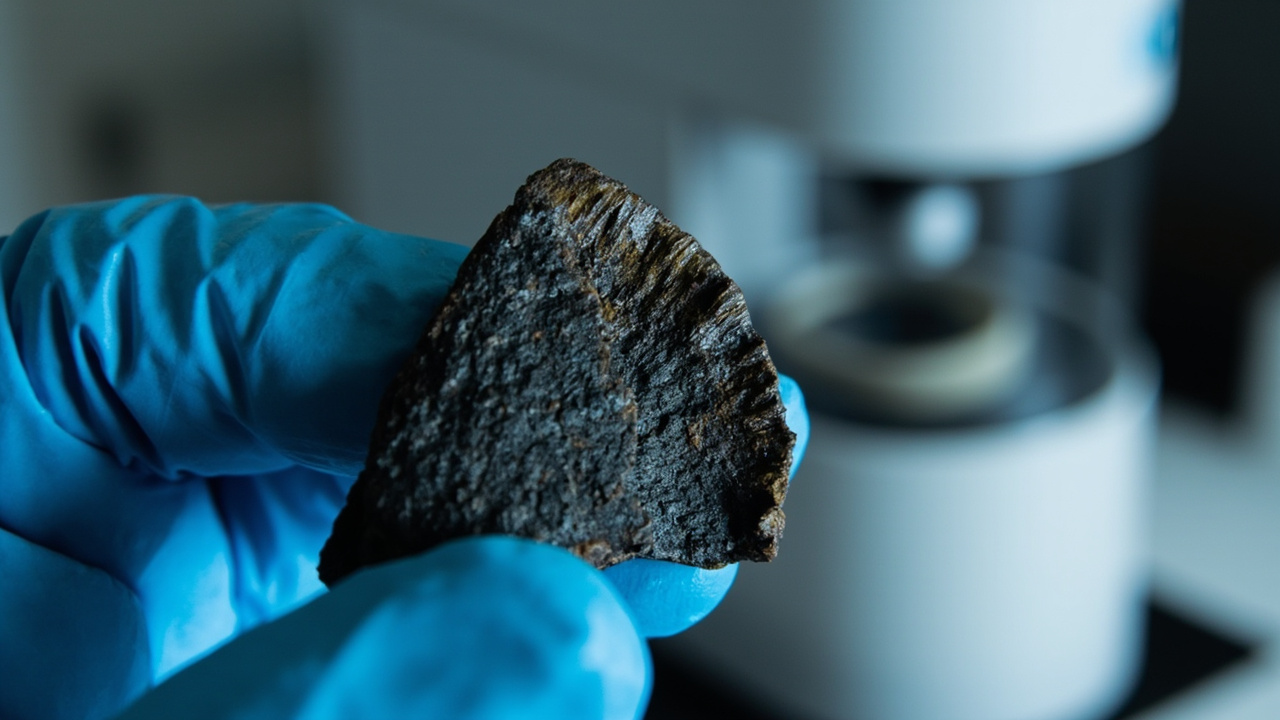
Sampling was deliberately small. Researchers removed about 5 milligrams of enamel powder — less than a pinch of salt — from each tooth with a low-speed rotary drill fitted with a tungsten carbide bit, according to Reuters. UCLA describes use of a dental drill to lift enamel, followed by dissolving the powder in phosphoric acid to release carbon dioxide carrying the isotope bonds. Pressurizing that gas created a denser stream of carbon dioxide, giving the mass spectrometer enough material despite the tiny starting sample.
Proving 66 million years did not rewrite the chemistry
Before calculating temperatures, the team tested whether burial had overwritten the original signal. They worked with enamel rather than bone or dentin because its large crystals and dense structure best resist chemical exchange over geologic time, according to UCLA.
Several lines of evidence pointed toward preservation. Enamel and dentin from the same teeth carried distinct isotopic signatures, an outcome unlikely if groundwater had homogenized the specimens. Infrared spectra resembled modern alligator enamel, carbonate levels matched modern reptilian enamel, and carbon isotopes retained the pattern expected for meat eaters, according to Ars Technica.
That screening step was central to the claim. Without it, a laboratory temperature could reflect Hell Creek groundwater rather than Cretaceous physiology. With it, the researchers treated the clumped-bond counts as biological thermometers.
The numbers: 37.3, 35.9 and 34.7 degrees
The two teeth from the young adult yielded 37.3 and 35.9 degrees Celsius. The isolated tooth gave 34.7 degrees. Combined, the measurements average 36.3 degrees Celsius, or about 97.3 degrees Fahrenheit, with an uncertainty of 2.5 Celsius degrees, or 4.5 Fahrenheit degrees, according to Reuters and Ars Technica.
UCLA places that value at 97 degrees Fahrenheit, almost the same as people. Reuters notes average human temperature is 98.6 degrees Fahrenheit, or 37 degrees Celsius. The authors compare the dinosaur more closely to the elephant, the largest living land animal at around 97 degrees Fahrenheit, and to the ostrich, the largest living bird at roughly 102 degrees Fahrenheit, or 39 degrees, according to Reuters. Ars Technica adds that the figure falls within uncertainty of large flightless birds such as ostriches and emus, while remaining cooler than small flying birds, which often exceed 41 degrees.
Modern cold-blooded reptiles generally operate near 28 to 30 degrees Celsius, or 82 to 86 degrees Fahrenheit, while most birds — the living descendants of theropod dinosaurs — commonly run at 40 to 43 degrees Celsius, or 104 to 109 degrees Fahrenheit, according to UCLA. By that scale, the new T. rex value sits at the lower end of the warm-blooded range, according to Reuters.
The crocodilian controls averaged 30.9 degrees, matching the 30-to-35-degree range modern crocodilians maintain by moving between water and basking sites, according to Ars Technica. The gap between T. rex and its Hell Creek crocodilians parallels the present-day gap between large mammals and crocodilians.
Senior author Aradhna Tripati, a UCLA geoscientist, said the animal stops fitting the popular image of a sun-dependent reptile and looks thermally closer to an elephant or ostrich than to a crocodile, according to Reuters.
Warmer than its rivers and summers
A warm tooth alone does not show whether the animal generated that warmth or simply lived somewhere hot. The team therefore compared the predator to its surroundings.
Fossil freshwater mussels from the same part of Hell Creek, which largely record summer water conditions, averaged about 26 degrees. A new high-resolution Late Cretaceous climate simulation with roughly 60-kilometer grid spacing tested colder and hotter cases. Even in the hotter case, the warmest summer months at Hell Creek reached about 33 degrees, with mean annual temperature near 21 degrees, according to Ars Technica.
T. rex was therefore consistently hotter than local water and air. The Science Advances abstract states that comparison with proxy-derived environmental temperatures and model simulations indicates the dinosaur maintained higher body temperature than its environment, while crocodilian teeth returned markedly lower values.
The researchers also considered sheer bulk. Very large animals can retain heat because volume holds warmth while surface area loses it slowly, a size effect called inertial homeothermy or gigantothermy. The juvenile T. rex temperature exceeded predictions from body-size scaling for a cold-blooded animal of its mass, although the authors acknowledge those scaling models are debated, according to Ars Technica. On balance, they interpret the pattern as adding to evidence for steady internal heat production, without treating the debate as closed.
A range that could reach Alaska
To test geographic implications, the group built a computer-based virtual species model. It drew thermal tolerance information from 465 living mammals and projected where an animal with the inferred temperature could have lived under Late Cretaceous climate simulations, according to Ars Technica.
The result pointed to broad access across the North American landmass, including colder and higher latitudes, according to the Science Advances abstract. UCLA collaborator Alessandro Chiarenza of University College London reconstructed a possible range 66 million years ago stretching from Mexico to Alaska for an animal holding near 97 degrees Fahrenheit.
That projection fits fossil geography. Tyrannosaurus remains are known from Alberta and Saskatchewan in Canada, south through Montana, Wyoming and the Dakotas, and into New Mexico and Texas, with tyrannosaur material also reported from Alaska, according to Reuters and UCLA. Researchers have noted an absence of lizard, turtle, crocodile and other ectothermic reptile fossils from Cretaceous Alaska, whereas tyrannosaur fossils occur there, a contrast UCLA presents as consistent with an animal less bound by external warmth.
Tripati said climate modeling suggests the species could have occupied most of the continent, including places that experienced freezing, describing a more mobile and adaptable animal than the classic sluggish image, according to Reuters.
What warm blood would have cost
Warm-bloodedness, or endothermy, means producing and retaining metabolic heat internally. It can support sustained movement, stamina and activity across warm and cold settings. Cold-bloodedness, or ectothermy, leaves animals dependent on outside heat, as in crocodiles and snakes, according to Reuters.
The price is food. Higher metabolic rates demand more energy intake and potentially more active hunting, longer search ranges and migration capacity, according to Reuters. Co-author Robert Eagle said an endothermic T. rex would have needed substantially more food to sustain its metabolism, while gaining the ability to remain active, seek prey and occupy colder places.
That tradeoff aligns with views of tyrannosaurs as active predators or scavengers rather than basking slow movers, according to UCLA. It also extends the evolutionary story: birds, which descended from small feathered theropods, now maintain especially high temperatures around 107 degrees Fahrenheit, or 42 degrees Celsius, in small flying species, according to Reuters. The new T. rex figure sits well below that avian extreme, suggesting an ancestor already operating with internal heat regulation but not at the level of its later flying relatives.
Why teeth succeeded where bone fell short
The practical advance may outlast this single temperature. Bone remodels, dissolves and regrows during life, complicating chemical records. Enamel, once formed, does not remodel and its crystals better survive underground, according to UCLA.
Eagle summarized the logic by saying the isotope bonds act as a thermometer because their abundance shifts with formation temperature. UCLA quotes him saying no group had previously made this kind of direct measurement and that the outcome — about 36 degrees Celsius — was higher than a reptile or slow mammal such as a sloth, but lower than a bird.
The Cretaceous setting makes the control data especially useful. The period was one of the warmest in Earth history, roughly 11 to 25 degrees Fahrenheit warmer than today, according to UCLA. Even against that hothouse baseline, T. rex stood out from its environment and from neighboring crocodilians.
For museums and geochemists, the reduced sample size changes what can be asked of rare fossils. A measurement that once required more bone than institutions would release can now proceed from milligrams of enamel, opening the possibility of testing additional species, ages and regions without major damage to specimens, according to UCLA.
Sources referenced
- T. rex teeth indicate it ran as warm as an elephant - Ars Technica (https://arstechnica.com/science/2026/09/t-rex-teeth-indicate-it-ran-as-warm-as-an-elephant/)
- Scientists finally know the body temperature of the Tyrannosaurus rex | UCLA (https://newsroom.ucla.edu/releases/scientists-finally-know-the-body-temperature-of-the-tyrannosaurus-rex)