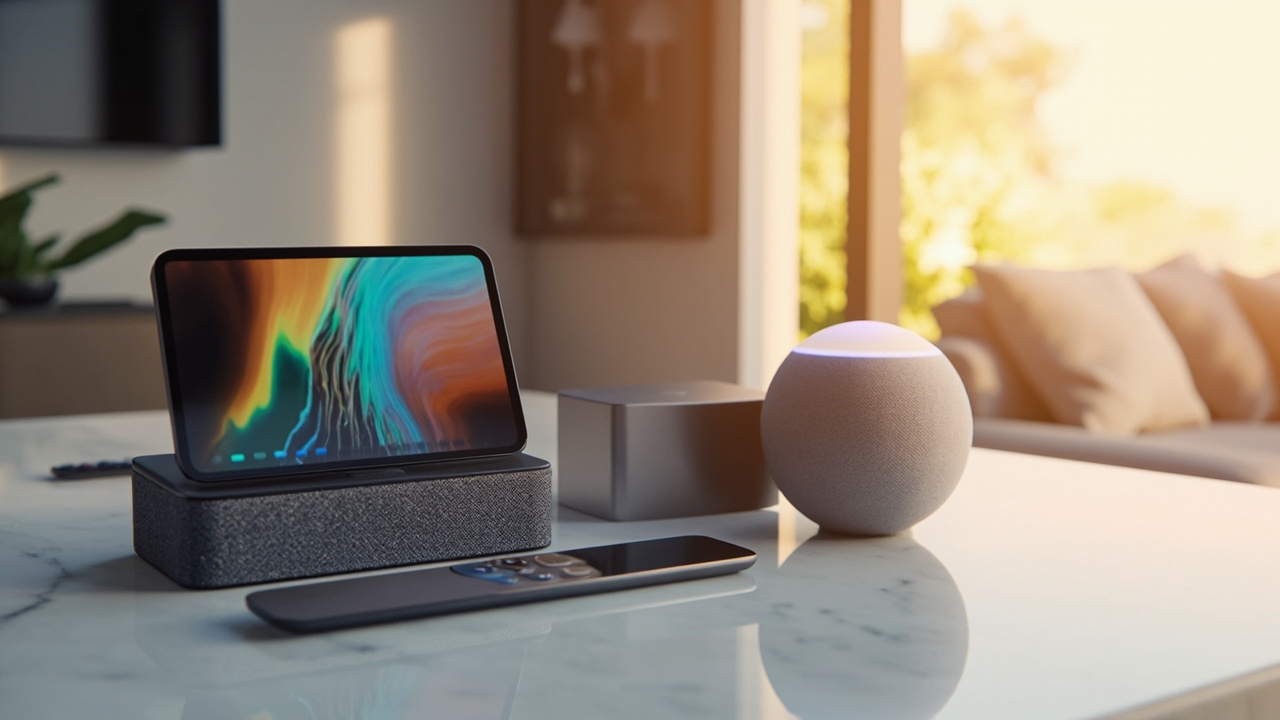
TL;DR: Apple introduced four smart-home pillars on October 13, 2026 — the $299 HomeView display, the $299 Apple TV 4K (4th generation), the $149 HomePod mini 2, and the Apple Home Collection accessory line — with pre-orders open now and staggered launches on October 30, November 13 and in December.
Apple staged its “Welcome Home” push as an invite-only showcase in New York City on October 13, 2026, paired with online press releases from Cupertino, California. According to coverage from Engadget titled “Everything Announced At Apple’s ‘Welcome Home’ Event,” the program centered on a first-of-its-kind hub plus refreshed living-room audio and video hardware and a partner-built accessory ecosystem. Reporting from The Verge titled “All the news from Apple’s ‘Welcome Home’ event” framed the same lineup as a broader smart-home effort headlined by HomeView and supported by new cameras, thermostats and a lock.
That framing matters for U.S. shoppers because everything Apple detailed is managed through the Home app, controlled by voice, and tied to a new conversational assistant. Apple calls that assistant Siri AI, describing it as an entirely new version of Siri built on the next generation of Apple Intelligence. Availability, language support and chip choices differ by product, and one headline feature for the smallest speaker arrives in a later update.
HomeView becomes Apple’s first smart display
HomeView is Apple’s first smart-home hub with a built-in screen. Apple’s newsroom release titled “Meet Apple HomeView, a new way to enjoy entertainment and manage the home” describes a 7-inch Liquid Retina display intended as a shared yet personal control point for music, video, calls, monitoring and automation.
Two physical versions cost the same. The tabletop model sits on a domed speaker base joined by a stainless-steel hinge that tilts for viewing on counters, nightstands and side tables. The wall-mounted model uses the same 7-inch display and feature set without the base, attaching with purpose-built hardware for entryways and hallways. Pre-orders started October 13, with availability beginning November 13.
The tabletop version comes in silver, starlight, rose pink and space gray with a matching cable. The wall-mounted version comes in space gray and silver. Apple lists mounts from Schneider Home with self-installation or professional-installation options.
Display behavior is tuned for distance and time of day. Apple says automatic brightness spans 500 nits for sunlit rooms down to 0.3 nits for bedside use, with True Tone adjustment. The interface shows simpler information from across the room and richer detail up close.
Personalization relies on face recognition for up to six people. Each person can receive an individual Home Screen with apps and widgets, plus access to personal content in Messages, FaceTime, Calendar, Reminders and Find My. Shared photo albums and music remain available to the household, including guests. Custom “faces” in an Apple Watch style can show four adjustable widgets, weather, photos and character animations.
Calling, entertainment and kitchen use are built in. A 12-megapixel front camera supports FaceTime calls, while music, podcasts and video streaming are supported directly. Apple says recipes can be followed step by step after tapping a cooking control, and content such as songs, podcasts, recipes and calls can transfer between iPhone and HomeView.
Power comes from the A18 chip. Apple’s materials associate that silicon with on-device processing for Apple Intelligence features and Siri AI. Four microphones support far-field voice input, and the tabletop base combines full-range drivers with a down-firing woofer and force-canceling passive radiators. The wall model is tuned for wall placement.
Apple says initial Siri AI support on HomeView is in English in the U.S., Australia, Canada, India, New Zealand, Singapore, South Africa and the U.K. Canadian French support is planned later through an update. Coverage from The Mac Observer notes that HomeView is not offered for sale in the European Union because Siri AI is currently unavailable in iOS there.
Apple senior vice president of Worldwide Marketing Greg Joswiak said the product is meant to be shared by everyone in the home while feeling personal to each user, shifting from a household screen to an individual experience, filling a room with sound, supporting FaceTime and simplifying smart-home control.
Apple TV 4K gets A19, hands-free Siri and four-speaker sound
The next-generation Apple TV 4K is Apple’s most performance-focused streaming box to date. According to Apple’s newsroom release titled “Apple unveils the new Apple TV 4K, supercharged by Siri AI,” the fourth-generation box centers on a full-screen conversational assistant, hands-free voice control and a larger surround configuration.
The A19 chip delivers up to 50 percent faster CPU performance and up to twice the graphics performance of the prior generation, in Apple’s comparison. A dedicated AV1 decoder is included for more efficient high-quality streaming with lower bandwidth use.
Three far-field microphones enable completely hands-free interaction. Apple says advanced echo cancellation isolates voice commands from background audio, allowing “Hey Siri” or “Siri” requests while content plays. Siri AI can search with follow-up questions, show poster art from the Apple TV app, answer contextual questions during playback in a compact overlay, and, when linked to an Apple Intelligence-enabled iPhone, respond to personal-context requests such as playing a show someone recommended.
The remote keeps a familiar shape but adds location tools. The new Siri Remote supports Find My with Precision Finding and can play an audible alert after a voice request. Apple says the fourth-generation remote is also sold separately and works with Apple TV HD and Apple TV 4K models.
Home-theater pairing expands to four speakers for the first time. Owners can combine the fourth-generation Apple TV 4K with four HomePod mini 2 units, or with HomePod second-generation units when front and rear pairs match. Apple says the system identifies speaker positions and calibrates timing and levels automatically.
The box also functions as a home hub. Compatible doorbell notifications can appear on the television, allowing viewers to see visitors, speak with them and unlock doors without stopping playback. Apple Intelligence-generated camera-activity descriptions and summarized notifications are part of the Home-app experience.
Pricing is $299. Pre-orders started October 13, with availability beginning November 13. Apple says Siri AI is also available in beta on Apple TV 4K second generation or later through tvOS 27.2, in English in the same eight launch countries and regions as HomeView.
Apple vice president of Worldwide Product Marketing Bob Borchers called the product the company’s most immersive home-theater experience, citing conversational full-screen search, hands-free microphones, expanded HomePod pairing and simpler management of Apple Home accessories.
HomePod mini 2 adds S10, Sound Glow and later Siri AI
HomePod mini 2 is the first major revision of Apple’s compact speaker. According to Apple’s newsroom release titled “Apple announces the next generation of HomePod mini,” the $149 speaker introduces Siri AI support, new colors, revised audio processing and closer ties to Mac and home theater.
Pre-orders opened October 13, with availability starting Friday, October 30. Colors are pink, green, blue, white and midnight. The price is $20 above the prior $129 U.S. store price noted by independent launch coverage.
Inside, Apple replaced the older processor with the S10 chip. Apple links that chip and computational audio to real-time optimization of dynamic range, loudness and acoustic performance. A single unit can fill a room, while two units form a stereo pair and multiple units support multiroom audio over AirPlay.
Sound Glow is the most visible change. The top surface becomes a light canvas that glows and pulses with music, reacting to bass and treble. Colors are generated from Now Playing album artwork, giving each song a different appearance, while soundscapes such as rain trigger separate animations.
The speaker can now serve as the default audio output for a Mac with Wi-Fi 6E or later, covering films, games, FaceTime and video calls in single or stereo configurations. For television, four HomePod mini 2 units paired with the fourth-generation Apple TV 4K can create what Apple calls its most immersive surround setup, with automatic calibration.
Siri AI is the headline software change but does not ship on day one. Apple says it arrives in a future free software update. Initial support is English in the U.S., Australia, Canada, India, New Zealand, Singapore, South Africa and the U.K. The owner of the home in the Home app needs an Apple Intelligence-enabled iPhone or iPad with current software and Siri AI enabled. The speaker can recognize up to six household voices and connect to personal apps such as Messages and timers.
Apple’s examples for paired personal-context use include locating a song mentioned in a text, setting a calendar- or location-linked reminder, finding a recipe from email and adding ingredients to a grocery list. People without a compatible iPhone or iPad can still use general knowledge, conversation and music-discovery functions once Siri AI is enabled on the speaker.
Smart-home and safety functions continue. The speaker works as a home hub, controls accessories by voice, runs automations, listens for smoke and carbon-monoxide alarms through Sound Recognition, sends alerts to iPhone, iPad and Apple Watch, and supports check-in listening and speaking through the Home app.
Apple vice president of Worldwide Home Product Marketing Kaiann Drance said the model combines Siri AI, new colors and room-filling sound, with richer music discovery, stereo and multiroom expansion, four-speaker home theater and voice-based accessory control.
Apple Home Collection brings LG and Schneider accessories
Apple Home Collection is a co-developed accessory line rather than Apple-built hardware. According to Apple’s newsroom release titled “Introducing Apple Home Collection, a new lineup of smart home accessories,” Apple worked with LG Electronics and Schneider Electric to create cameras, thermostats, sensors, a video doorbell and a door lock that pair like AirPods or HomePod and run entirely from the Home app.
Setup starts with a single tap from iPhone using Bluetooth and NFC, Apple says. No separate app or account is required. Communication is end-to-end encrypted in Apple Home, meaning Apple, LG and Schneider cannot read home data, according to Apple.
Monitoring hardware comes from LG. All four cameras capture up to 2.5K video, recognize people, familiar faces, pets, vehicles and packages, and store history in a supported iCloud+ plan without a separate camera subscription. The Video Doorbell adds dual views for visitors and packages, a built-in spotlight and chime playback through HomeView, HomePod and HomePod mini. The Floodlight Cam pairs motion-triggered dual floodlights with low-light color night vision. The Outdoor Cam offers adjustable low-light color coverage for self-installation. The Indoor Cam can tilt upward and downward automatically, pausing monitoring when the first household member returns.
Access control centers on the LG Smart Deadbolt Lock. According to reporting from The Verge titled “The new Apple Home Collection includes a video doorbell, smart lock, and more,” the $349 lock supports Apple Home Key with hands-free unlocking over ultra-wideband, plus keypad PIN entry and a concealed physical key. It replaces a U.S.-style deadbolt, uses Matter-over-Thread and supports the Aliro lock standard.
Climate products come from both partners. LG and Schneider each offer a Smart Thermostat starting at $199.95 in the U.S., with room and temperature sensors at $39.95. Schneider also lists thermostat mounting accessories. Adaptive Temperature can use on-device intelligence to adjust for home, winding-down and away states.
Prices reported by 9to5Mac and Apple store listings start at $39.95 for sensors and rise to $199.95 for the indoor camera, $249.95 for the wired video doorbell, $299.95 for the outdoor camera, $349.95 for the deadbolt and $399.95 for the floodlight camera. Apple says availability for the lineup begins in December, with select accessories following in early 2027.
In CNBC’s report titled “Apple releases HomeView smart home hub to showcase Siri AI,” Apple positioned the hub, speaker, set-top box and partner accessories as one connected system. That report also noted the new $299 Apple TV price, the $149 HomePod mini price and the role of Siri capabilities released the prior month as the software thread tying the event together.
Sources referenced
- Meet Apple HomeView, a new way to enjoy entertainment and manage the home - Apple (https://www.apple.com/newsroom/2026/10/meet-apple-homeview-a-new-way-to-enjoy-entertainment-and-manage-the-home/)
- Apple unveils the new Apple TV 4K, supercharged by Siri AI - Apple (https://www.apple.com/newsroom/2026/10/apple-unveils-the-new-apple-tv-4k/)